
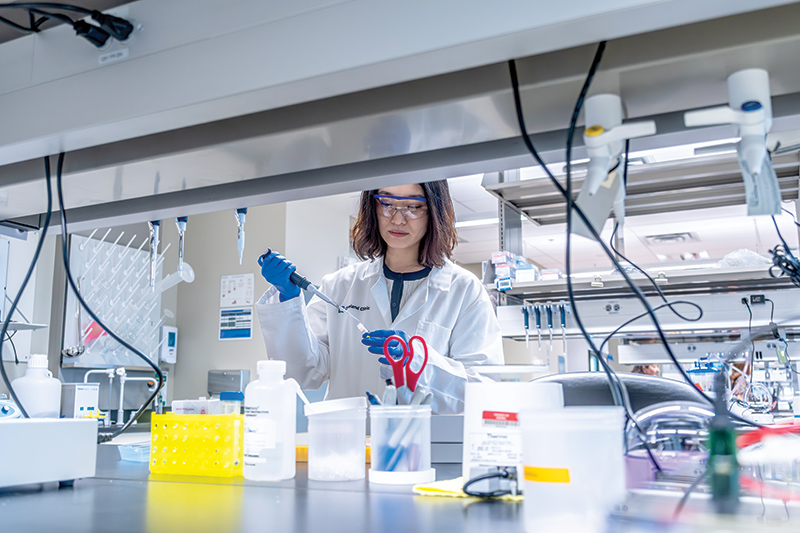
Recently transplanted researchers Mike Nicosia, Ph.D., and Juyeun Lee, DVM, Ph.D., spend their days at the Florida Research and Innovation Center in Port St. Lucie studying ways to improve organ transplant and brain tumor outcomes, and they often spend time at home talking to each other about science.
The married research doctors moved from Ohio to Florida this past April to begin their positions at FRIC. Both study the immune system, with Nicosia looking for better ways to prevent organ transplant rejection, and Lee researching how the immune system interacts with brain tumors, specifically glioblastoma.
The two met during their postdoctoral training when they worked in neighboring research labs at Cleveland Clinic in Ohio, and where they both stumbled upon the research areas they’ve come to love.
Nicosia, who spent nine years in Ohio, recalls the first time he looked out of his lab in Ohio and saw Lee, a seven-year Cleveland Clinic veteran. He was instantly captivated, and “the rest is history.”
Both doctors maintain their connections with the main campus for ongoing projects and collaborations.
Asked about their move to Florida and what attracted them to the Cleveland Clinic FRIC, they said they were enticed by the opportunity to conduct research at a growing medical research center.
“We were really excited about this opportunity,” Lee said.
“We can really take the lead and drive it the way we want,” said Nicosia.
Their complementary expertise and commitment to their research highlight both the challenges they face and the hopes they have in advancing treatments for the complexities of glioblastoma and organ rejection.
Lee, 39, discovered during immunology training in Ohio her interest in how the immune system interacts with brain tumors, especially glioblastoma.
“I find brain tumors very interesting,” said Lee, explaining how her research investigates why men are more susceptible or have worse outcomes than women by examining the immune responses by biological sex and age. Lee hopes to eventually expand her study to other types of tumors.
“There’s no known cause of glioblastoma,” said Lee, also noting the difficulty treating the disease with chemotherapy due to the blood brain barrier that protects the brain.
Her lab, the J. Lee Lab, investigates the mechanisms by which biological sex shapes anti-tumor immune responses in glioblastoma, with the goal of developing sex-informed therapeutic strategies to improve immunotherapy outcomes. Studies include T cell immunometabolism, epigenetic regulation of T cell differentiation, and the neuroimmune-endocrine axis, all of which contribute to sex-biased anti-GBM immune responses.
Lee received veterinary training at Kyungpook National University in South Korea and earned her Ph.D. at Mississippi State University, where her research focused on host-microbe interactions. Her postdoctoral training took place at Cleveland Clinic in Ohio, where she studied the role of regulatory T cells in autoimmune diseases. As a postdoctoral fellow and research associate, she expanded her research interest to brain tumors.
Nicosia, 38, leads a research program aimed at improving transplant outcomes and addressing the elevated cancer and infection risks faced by transplant recipients due to side effects of transplant rejection drugs.
He was educated in the United Kingdom at Keele University, where he did both his undergraduate work and received his Ph.D. in structural biology. He moved to the United States for research and today focuses on understanding how the immune system can be selectively restrained to protect transplanted organs without broadly suppressing immunity.
His lab studies inhibitory immune pathways that act as natural “brakes” on immune responses and explores how these mechanisms can be harnessed to prevent organ rejection while reducing the long-term risks of infection and cancer faced by transplant patients.
“I’m trying to find a new approach to rejection,” said Nicosia, relating the story of a person who had a kidney transplant but got sick with melanoma caused by anti-rejection drugs. The patient was successfully treated for the melanoma, but later needed to go back on dialysis while waiting to replace the transplanted kidney.
“We just don’t know how to balance these two responses,” Nicosia said.
He also talked about the excitement that was generated by xenotransplantation, which is transplantation using pig organs. But the field remains focused on improving current therapies as most researchers contend that xenotransplantation is not the way to go due to scientific and ethical challenges.
While he began studying organ transplant rejection by accident, Nicosia could not be more pleased. “Once I got into the field, I fell in love with the complexity,” he said.
The research immunologist focuses on immune regulation in transplantation. His work examines inhibitory immune pathways that control antibody- and cell-mediated rejection, with the goal of developing more targeted strategies to preserve transplanted organs while minimizing the harmful effects of long-term immunosuppression.
As young researchers, both benefited from Youth Investigator Awards which helped them establish their independent research programs. In addition to their research at the lab, they spend a good deal of their time writing grants for the additional funding needed to advance their work.
Asked whether their relative youth affects their work, the scientists said they aren’t concerned about earning respect for their science despite their age.
“I think it’s more about how I deal with my science. I just want to do good science and let the science to the talking,” Nicosia said.