
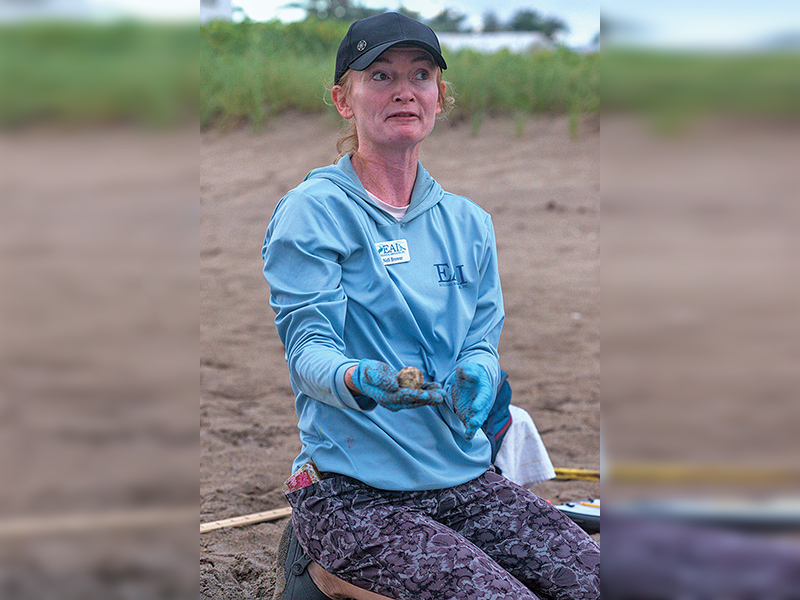
It’s a somber but common sight: From 100 turtle eggs, only one comes out alive from the nest.
Nell Brewer, a local biologist, dived into the sand with gloved hands on Glascock Beach in South Hutchinson Island early Aug. 7.
She carefully marked her dig site, one of 19 nests around her, with a circle. The perimeter cordoned off sand wet from rolling thunderstorms and rising tides, which adorned the beach with drying seagrass. By daybreak, she collected a clutch of 115 eggs. Most were intact. In front of 12 hikers, she recovered three turtle hatchlings, two of which died digging upwards against 3 feet of sand.
The morning’s sole survivor was one of three hatchlings who lived among 16 from the nest. Its recovery brought comfort to the hikers as Brewer brought it to the shore. It could barely waddle toward the water, but the creature remained determined.
The tradeoffs of nature highlighted the first of four Friday morning turtle nest excavation tours this summer. Marine biology firm Ecological Associates, Inc. (EAI), which monitors St. Lucie beaches, and the county’s environmental staff patterned their tours around turtle births, either miraculous or tragic.
The clutch Brewer collected had incubated for “56 days” under 3 feet of sand, according to EAI Biologist and Outreach Coordinator Lauren Maline. That long wait preceded the three-day period before Brewer and other EAI workers could dig for the nest upon the first signs of hatching.
These realities factor into each tour, said Maline. “There may not be hatchlings at every nest.” She added: “What is below the surface remains a mystery till we dig it up.”
EAI, said Maline, marks each nest used for the tours “in areas where beach furniture and umbrellas are used.” This case includes those closer to the condo complexes near the St. Lucie/Martin county line.
“For this reason,” Maline said, “we do not monitor these nests daily for signs of over wash by tide.” She added, “however, we would record things like predation activity or wash out.”
The Glascock nest avoided predation from birds and mammals like raccoons, Maline said. EAI, though, found signs of “ghost crabs” (of the genus Ocypode) invading the nest during excavation. “It is difficult to say what may have impacted the hatching success.”
The Aug. 7 tour offered only one glimpse among thousands of turtle nests. One hiker, Gail Strain, showed Brewer and others a video of a lively nest, with hatchlings crawling over each other. She filmed the footage near her North Hutchinson Island home around 1 p.m. July 25.
High temperatures added to their struggle to the sea, Strain said. The heated sand left them “frying” as she wondered “what is it we can do for them. It was beautiful and sad at the same time.”
Another hiker, Denise Shutt, praised Brewer’s explanation of turtle hatching, along with its variable success. “I had hoped there would be more viable turtles,” said Shutt. “It looked like most of them did not survive.”
Shutt added a hopeful note drawing from how long the lizards had been on Earth: “They’ve done it for millions of years.”
Two of the remaining tours, Aug. 14 and Aug. 21, reached their capacity of 25 hikers as of Sunday, according to the St. Lucie website. Another 14 spots still remain for the final Aug. 28 tour; if interested, visit SLChikes.org.
Visitors, Maline said, must stay out of the turtles’ way, regardless of their situation. This includes keeping at least 3 feet from nest sites; contacting the state Fish and Wildlife Conservation Commission if they find hatchlings “in distress”; and avoiding any physical contact with them.
“They imprint on the beach at which they were laid so they know where to come back to for nesting,” Maline said. Any intervention to “’help’” young turtles “is unlawful and will disturb the hatching/emerging process.”