
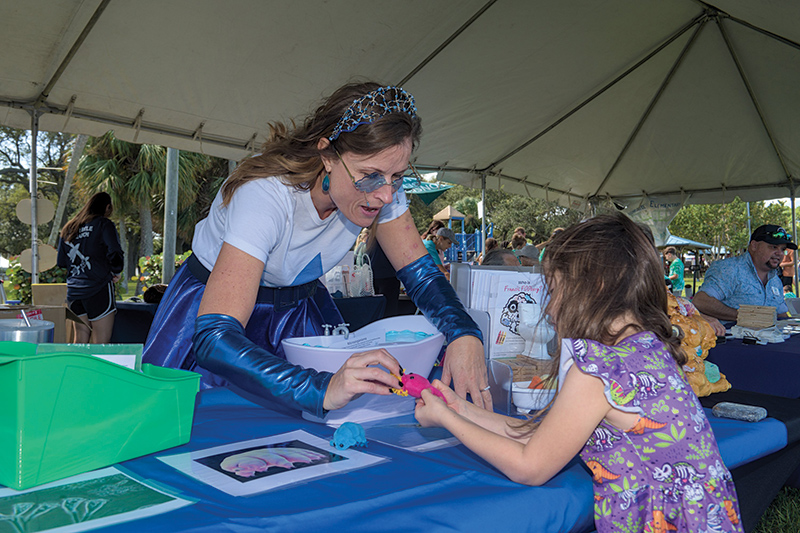
High winds and a location change hardly stopped the exploration of wonders in surrounding waters at the 2026 Indian River Lagoon Science Festival Oct. 24.
Now in its 11th year, the Science Fest returned to its first-ever location at South Hutchinson Island’s Harbor Pointe Park. The morning through early afternoon brought exhibitors – from activists to utility workers – closer to the event’s namesake waterway.
Visitors were out in force even as exhibitors scaled down their displays due to strong winds. It brought many within reach of the Smithsonian Marine Station, 701 Seaway Dr., a nucleus of information given through fun activities to visitors of all ages.
Ongoing road construction along Indian River Drive moved the event from its longtime home between the River Walk and Manatee centers, said Jennifer Sneed, a Smithsonian Research Biologist and Festival Committee Chair.
The public’s love of what lies beneath benefited the neighboring St. Lucie Aquarium, 420 Seaway Dr.. They tallied 924 visitors, one of their most successful days ever, according to Marine Educator Chelsie Corcoran.
Involvement with education still resonates with visitors and exhibitors. Events like the Oct. 24 festival “let them know what science is going on in the Treasure Coast,” said Sneed. “Most of the exhibitors we have here are practicing scientists.”
The day’s turnout brought back regulars from local marine biology mainstays: from fellow Smithsonian staff to the researchers at Florida Atlantic University’s Harbor Branch campus. All welcomed new visitors to learn about the lagoon, along with what trends – manmade and otherwise – affect its health.
The West Palm Beach-based Angari Foundation, in their first appearance, coordinated a table of drift cards, thick cardboard slabs covered with children’s drawings to trace ocean current patterns with the University of Florida’s Sea Grant program.
“A two-level citizen science” project, these cards will be spread throughout the Lake Worth and Indian River lagoons Nov. 10, according to Sea Grant Extension Agent Dr. Vincent Encomio. Cards floating throughout the St. Lucie Inlet will be tossed from Stuart’s Twin Rivers Park (3505 SE Kubin Ave.) and the Jensen Beach Causeway (2004 NE Causeway Blvd.).
These cards can give insight into how currents push marine wildlife, potential pollutants, and even how water can erode beaches. “When people find them, they’ll take a photo of the card and give us the information on where they found it and when,” said Encomio. “We not only get the distance it traveled, but how long it took.”
Johnny Velarde, a marine educator tied to the Oxbow Eco-Preserve (5400 NE St. James Dr.), has developed a team project on oyster restoration since summer 2025. His research and educating young people progressed under the guidance of Oxbow Director Erin Cartmill.
Velarde’s work uses artificial reefs built from old, donated concrete structures. These and other reef materials are inspected under “every degree measurable,” he said, before oysters could stick to their surface.
Bringing oysters back could be “a dramatic change for the better,” Velarde said. “An oyster inside the Indian River Lagoon is a keystone species,” supplanted with the “superpower” ability of each oyster filtering an average 50 gallons of water daily.
Barbara Brown founded the Docks for a Clean Lagoon nonprofit with the same goal in March. Since then, she has regularly collected discarded oyster shells from Treasure Coast restaurants to encourage growth in natural seabeds and artificial reefs.
“There used to be a huge amount of oysters growing here,” Brown said. Her research referred to their presence among the indigenous Ais people spanning a millennium ago, supported by dug up “shell mittens” of their own discards.
Colonization and land speculation cut their numbers, with many oyster shells used in road and rail construction since, Brown said.
“I have a two-point goal in mind: one is to clean the lagoon because the more oyster shells there are, the more oyster colonies that grow,” she added. The other goal remains in communication: “A lot of people aren’t aware they can even do anything. They think ‘it’s all the scientists,’ but they don’t even realize anything’s even being done.”
“It’s humbling for the scope but it also fuels me,” said Velarde, who first fell for water conservation on a field trip. “I feel a continuation of that (and) feel that together, we can accomplish anything.”