
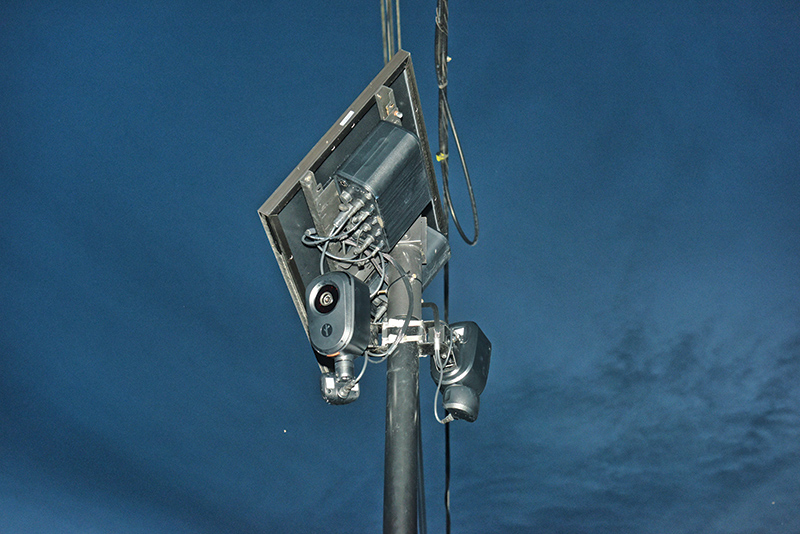
Controversy over artificial intelligence-powered traffic cameras continues to take hold in St. Lucie, especially as officials try to decode where several of them came from.
County staff investigated the presence of 13 “unpermitted” Automated License Plate Reader (ALPR) cameras along their roads, according to St. Lucie spokesperson Erick Gill.
Most of these cameras can be found along 25th Street throughout downtown Fort Pierce, county records show. St. Lucie surveys located them at the intersections of Avenue I, Orange Avenue and Edwards Road.
Others are located on more rural roads, including two at the intersection of Glades Cut-Off and Carlton roads and another along Range Line Road just north of the Martin Correctional Institution.
These cameras appeared in several media reports including local newspapers and TV affiliates throughout September; and in an Oct. 1 Washington Post article.
Over a month has passed after the Board of County Commissioners voted to remove all of these cameras, many made by Flock Safety of Atlanta, from county roads Sept. 1. They agreed with county staff to remove 65 cameras – including 52 once authorized in the County Sheriff’s jurisdiction – by Tuesday, Oct. 13.
The county will wait until Tuesday to remove these cameras, said St. Lucie Communications Director Erick Gill in an Oct. 1 email. He added some cameras may be covered under black tarps “so that they cannot record” pending their removal by the county or the Florida Department of Transportation.
The count of 13 unauthorized cameras is a change from the 14 Interim County Administrator Mayte Santamaria said in an update on the cameras’ removal Sept. 15. One of these cameras was found on a Port St. Lucie road rather than a county road, added Gill.
The nationwide controversy over Flock Safety cameras remains tied to their original intent to reduce crime and promote safety, a common denominator for Port St. Lucie, often named one of the country’s safest places to live.
Port St. Lucie’s police department has kept up an “operational pause” on the use of their 126 ALPR cameras since Aug. 31, records show. Their operations have undergone nearly six weeks of internal review, limiting their use only to “exigent circumstances” including life-threatening violence and the investigation of missing children.
Port St. Lucie police, who uses cameras made by Flock Safety and Axon, “does not have any unpermitted ALPR cameras,” said Port St. Lucie Police Department spokesperson Ofc. Brittany McNally in a Sept. 22 email.
Their measures around these cameras, records add, include deleting data gathered by the cameras seven days after their collection.
Promises to limit camera use do little to assuage some who live here, including Casey Hunneycutt. A resident of Sandpiper Bay for nearly 30 years, he appeared before the Port St. Lucie City Council for the second time in his life Sept. 28 to protest the cameras after first appearing Aug. 31.
“We have been told that these cameras are a ‘force multiplier’ for police,” Hunneycutt said Sept. 28, adding he believes Port St. Lucie’s police, among other law enforcement agencies, “enjoys a monopoly of force.”
This activity continues to worry Hunneycutt, who has a background in video editing and data management. Using metadata – or location data embedded in a video’s code – translates to “a Fourth Amendment violation” against unwarranted searches, he claimed in an Oct. 1 interview.
That casts a shadow of doubt on the city police’s policies of using their ALPR camera network. “I don’t think it’s progressed at all,” Hunneycutt said of their latest policies. “Flock is still using that data to improve their products. Just having this collection of data is a vulnerability.”
“Very light encryption,” as gleaned from Ben Jordan – a YouTube-based security researcher who exposed the “off-the-shelf” nature of Flock Safety cameras – brought attention to Hunnycutt of their exposure to hackers, he said.
“Once you have access to the network, you have access to every camera in that network,” added Hunneycutt.