
A new fiscal year and its challenges loom around the corner for St. Lucie starting Oct. 1, one with budgets strained by ongoing inflation and promises of property tax cuts.
Last week, Port St. Lucie and St. Lucie County each approved budgets close to $1 billion amid concern about state ballot Amendment 3, which, as critics have pointed out, could slash municipal revenue by large margins if approved Nov. 3.
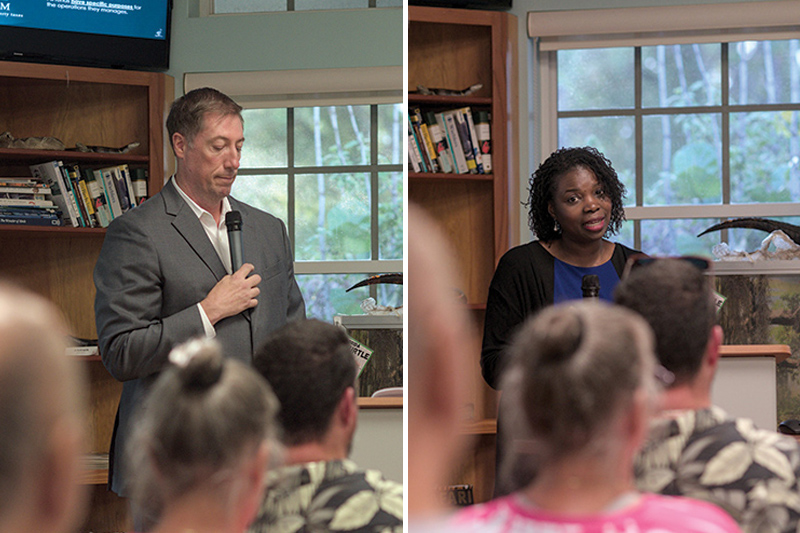
Municipal workers echoed this worry in several homeowner workshops, including one held Sept. 17 at the Oxbow Eco-Center and Preserve, 5400 NW St. James Dr.
If passed, Amendment 3, state documents say, would greatly increase tax exemptions for homes granted Homestead Act protection based on their assessed value.
Upon approval, homes are taxed at a lesser value than what they were bought for. Exemptions are currently capped at taking $51,411 off this price. If passed, Amendment 3 would raise these exemptions to $150,000 next year, and to $250,000 in 2028, leaving a much smaller property tax intake.
That poses a severe risk for Port St. Lucie. Approximately “62 percent” of its homes have been granted Homestead Act exemptions, said city Communications Manager Scott Samples before a group of 25.
Property tax income makes up $128.9 million (13 percent) of Port St. Lucie’s $971.5 million budget for next year, city records show. It is already $101.7 million greater than the city’s $869.8 million for this year, having been formulated to combat growing inflation costs.
Port St. Lucie, if the amendment passes, would see a “significant decrease” in their property tax revenue “to $80.5 million” in two years, said Samples. He added, referring to its language, that new homeowners moving into Florida seeking Homestead Act exemptions would “have to wait five years to get these benefits.”
Further exemptions, Samples said, “could lead to more people moving to Florida.” More growth could mean larger home prices, inflation, and roadway demand that could drive more cost-of-living surges statewide.
That primes St. Lucie, which brought in nearly 70,000 new moves since 2021, for some of the state’s biggest shortfalls, according to groups like the Florida Association of Counties. These losses would bleed funding for “services that residents have told us matter the most to them,” including first responders, parks, infrastructure and events, said Samples.
The U.S.’s top three credit agencies – Moody’s, Fitch and Standard & Poor’s – have shown concern about Port St. Lucie’s ability to borrow money “needed for large capital projects,” especially bonds for new roads and buildings, added Samples. “That means taxpayers may be paying more and getting less.”
The city’s latest budget, to be given final approval Monday, marks the 11th straight year of millage reductions since 2015, with approximately $4.88 taxed for every $1,000 of home value.
It has provided “real savings for homeowners” of approximately $2,000 per homeowner in that time, said city Office of Management and Budget Director Caroline Sturgis.
But homeowners seeking more savings by voting for Amendment 3 could unintentionally cost them valuable city services.
“Just like families, we have to make tough decisions,” she added after her presentation. “We may not be able to do everything.”
Port St. Lucie, according to Sturgis, has a slate of 190 project requests totaling approximately $1.7 billion in their Capital Budget. Of this queue, the city will pursue the buildout of a “recommended” 112 projects costing $1.1 billion over the next five years.
“Only the first year of that is funded,” said Assistant City Manager Kristina Ciuperger of 62 projects costing $245.7 million to begin next year.
City salaries make up 21 percent of the new budget in its general fund, according to Sturgis. But for Port St. Lucie, which welcomed “11,000” new moves in 2025, these risks and price hikes left no room “to build in” any new city jobs.
St. Lucie Communications Director Erick Gill also spoke at Oxbow of budget developments on the county level. He repeated County Commissioners’ Aug. 4 approval to let voters renew the county’s half-cent tax, in effect since 2018, to pay for services two years ahead of its originally scheduled 2028 expiration.
If renewed by half of county voters in 2026, St. Lucie’s half-cent tax could give the city $173.9 million toward roads over the next 10 years, according to Ciuperger.
County and city leaders budgeted in line with these challenges, buoyed by funds left over from previous years. But a different perspective around promised cuts arose compared to leaders’ questioning it in past weeks.
At the same time of the Oxbow meeting, the Board of County Commissioners unanimously approved St. Lucie’s approximate $969.3 million budget. Like Port St. Lucie, it will use a reduced millage; in this case, around $7.83 for each $1,000 in home value.
The board lauded county budget heads Jennifer Hill and Jennifer Garrity at what Commissioner Cathy Townsend called the end of “a very great year.”
“I think we’ll probably be seeing some more next year,” said Commissioner Larry Leet on the possibility of further millage cuts.
Commissioner James Clasby similarly commended staff for facilitating the “fifth largest” millage reduction since 1995. “We can always improve next year,” he said, in agreement with Leet, “should Amendment 3 pass.”
The same conversation occurred in the Port St. Lucie City Council’s workshop meeting Monday while approving an extension of their current mobility plan’s deadline from 2045 to 2050.
Much of that plan, prepared by NUE Urban Concepts of Gainesville, uses similar road improvement info as past proposals in 2022 and 2025, documents say. The total slate of new roads would require the city to invest $2.2 billion: $1.7 billion of which is left “unfunded.”
The potential losses due to Amendment 3 and the potential population growth it could stoke in promising lower taxes “would be borne by people other than developers,” said NUE Principal Jonathan Paul before the City Council.
The “huge responsibility” of paying for their projects against more cuts, said Vice Mayor Jolien Caraballo, “creates a huge discrepancy in the system that doesn’t allow us to address (homeowner) concerns.”
“We are not going to have, according to what I’m seeing, the level of funding necessary to meet those needs,” Caraballo added, of a disconnect between the Port St. Lucie and state governments.
“Growth is never going to pay for itself because we are always capped,” said Mayor Shannon Martin. “Unfortunately, people aren’t listening.” She added “costs,” particularly in new construction, “are never going to go down. Things fluctuate, but they never go down.”
“That has a lot of implications as we talk about affordable housing,” said Anthony Bonna Sr., a past proponent of a 2018 Homestead tax cut that failed.
“I think we have found the sweet spot because it’s important for developers to pay their fair share,” he added. “But I don’t think we’re doing anything that’s going to have devastating effects of housing affordability.”