
St. Lucie extended the timeline for hiring quotas from five to eight years for Project Orchid, a construction materials firm, to operate here.
On Aug. 19 County Commissioners unanimously approved a new hiring timeline to Project Orchid – codename for an unidentified South American window and aluminum maker with a Miami office – to hire 1,005 workers throughout eight years of operation.
The agreement, according to Planning & Development Director Ben Balcer, AICP, requires that the manufacturer meet these goals, which will give work paying at least $28.48 per hour, or “116 percent” of the average county wage.
Project Orchid will have to hire 80 workers in each of its first two years of operation. The quota will rise to 120 jobs for years three and four; 150 each in years five through seven; and 155 in year eight.
The county extended their quota after talks with Project Orchid since February, when it formed their new Job Growth Investment Program (JGIG). Through the program, St. Lucie can award them a cumulative sum of up to $2.01 million if they meet their goals each year. If the firm fails to meet “85 percent” of their yearly hiring quota, they will forfeit the award.
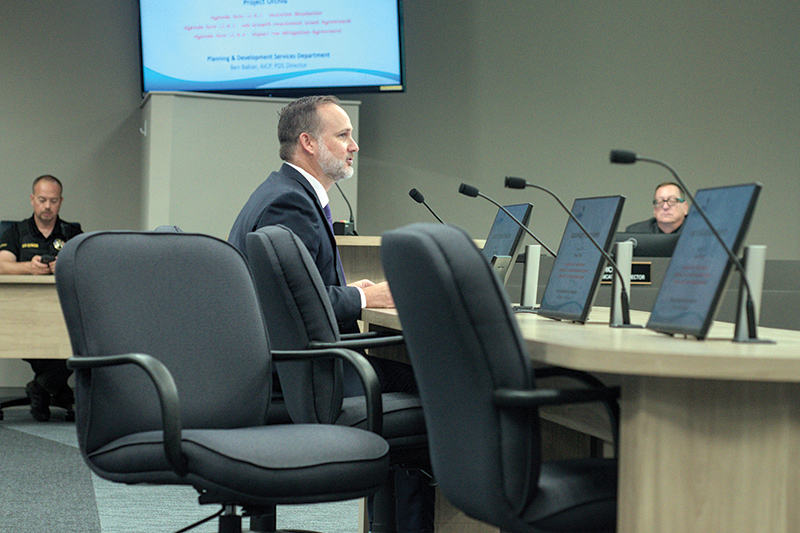
“The project is significant because of both projected capital investment and overall job creation,” Balcer said before the commission. He reiterated the total number of jobs remained the same as their timeline grew.
The new agreement arose after the county began “upping the ante” toward screening potential corporations to give job growth subsidies, said Commissioner Larry Leet. “We don’t let them just come in and take our money.”
“This year, I think we’ve had to stop three different companies from getting the mitigation,” Leet said. “They do have to qualify, and there’s an incentive to try and be competitive with the other communities in the area. Since that time, we have (restricted) the incentive and made it better for the constituents. It’s not a free ride coming in, but an incentive for job growth.”
Despite voting for the agreement, Commissioner James Clasby foretold of some conflict with the plan. “I look at everything through the lens of Amendment 3 at this point,” he said of recent legislation on the ballot.
State Amendment 3, were it to pass by a 60 percent vote in November, would raise home tax exemptions, particularly for those given protection under the Homestead Act. Their exemptions would increase from $25,000 to $150,000 in the first year of enactment and to $250,000 in the second, state documents say.
That could lead to the county losing approximately $1.06 billion over the next five years, according to Florida TaxWatch. Its projected losses, starting at $127.7 million next year, would be the 13th highest among the state’s 67 counties.
This “catastrophic reduction in revenue,” added Clasby, would leave St. Lucie in arrears toward the Project Orchid deal. “What’s the legal ramifications for that? Can they sue us? Do we have to pay them?”
“We wouldn’t have the money all up front,” said interim County Administrator Mayte Santamaria to Clasby. “We’d have to budget it year-by-year.”
Plans for the manufacturer include a $310 million, 1.3 million-square-foot factory along Rock Road between Orange Avenue and Interstate 95, county records show. Commissioners granted Project Orchid the land across two votes May 5 and May 19.
Construction on the Project Orchid plant itself would generate approximately 852 jobs and $207 million in labor output, Balcer estimated. The manufacturer, once active, could possibly generate as many as 1,953 jobs and nearly $559 million in output over 10 years.
Building a factory for Project Orchid could also potentially risk environmental harm. The manufacturer has already faced opposition toward building a plant in the Southern U.S., specifically near Atlanta.
At least three Change.org petitions gathered a combined 3,308 signatures since March to oppose a factory in Jefferson, Ga. The public outcry caused Project Orchid to withdraw from setting up a 158-acre facility there by July 21, according to Jefferson city records. None of the petitioners replied to requests for comment.
Corrections
A previous version of this story contained several inaccuracies.
St. Lucie will not be giving, as reported, $310 million to build a factory for Project Orchid, a manufacturing firm, in the unincorporated county. “No taxpayer money is going to the plant,” said Wicker Perlis, communications director of the county’s Economic Development Council.
The $310 million in question refers to potential capital improvements over a 10-year period once Project Orchid establishes a St. Lucie facility.
The only county money going toward Project Orchid would be job growth subsidies to be given if they reach yearly job quotas: amounts “nowhere near $310 million,” Perlis said. These amounts, county records add, would be no more than $2.01 million.
The Board of County Commissioners voted not to approve the plant’s construction but “updated incentives proposals” for job growth, added Perlis. “These votes were not related to site plan approval or construction permitting.”
The article also misstated that the factory, if built, would “be fully exempt from property taxes for the first five years of operation.”
“The county approved an exemption for ad-valorem real estate property taxes,” said Perlis. “The factory would still pay a lot In property taxes, including full taxes on (manufacturing equipment) to all taxing authorities, including St. Lucie County. Moreover, the county can only provide abatements for its portion of the tax bill.”
County Commissioner Larry Leet’s remark of “upping the ante” referred not to the factory itself, but to how the county “increased the scrutiny it puts on companies that receive incentives, ensuring they live up to their end of the deal,” said Perlis.
The article also contained unclear language on State Ballot Amendment 3, an ongoing concern for voters come November. The legislation promises, upon its passage, to increase tax exemptions from $25,000 to at least $150,000 for home value for those applied under Homestead Act protection. Multiple agencies have criticized Amendment 3 for potentially curtailing municipal income. “Amendment 3 doesn’t guarantee a cut,” said Perlis, “since it only impacts the taxable value side of the tax bill equation.”