
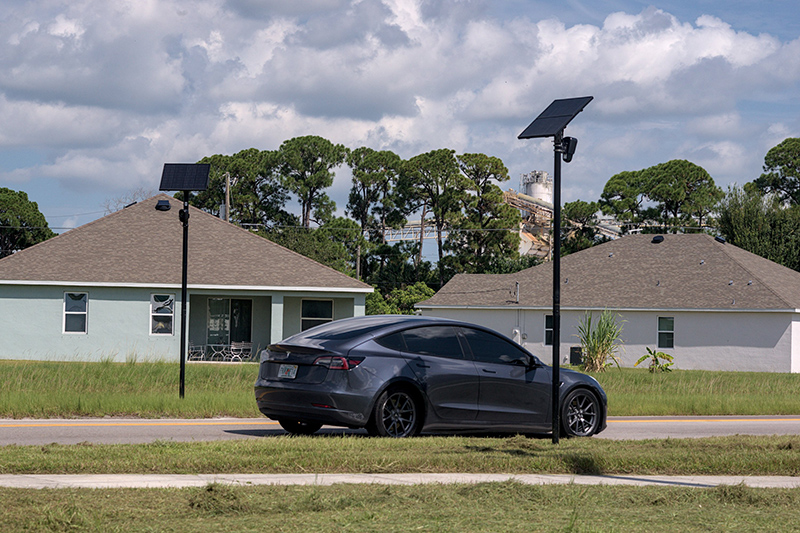
Concerns of enhanced national surveillance led to audience overflow at Monday’s Port St. Lucie City Council meeting.
Mayor Shannon Martin called for a weekly audit of cameras used by the city police department after waves of outcry over their misuse hit the floor a second time this month.
Police will shorten the retention period for driver data collected by cameras contracted under Flock Safety, an Atlanta security firm known for using artificial intelligence in their law enforcement tech.
The city will shorten a data-keeping period using these cameras from 30 days to seven. The Florida Legislature established limited statutes requiring police agencies to “self-limit” by deleting data 90 days after their collection, state records show.
Each camera, according to the Flock Safety website, can capture detailed photos of each vehicle in their sight. They include license plate numbers, exterior damage, decals, and accessories along with route projections for each vehicle at the time of recording.
The City Council was quick to address their use, which state legislation has expanded over time.
“This didn’t happen overnight,” said Council Member Anthony Bonna Sr., in reference to the Florida Supreme Court revoking city-level enforcement of red-light laws in 2014, which Gov. Ron DeSantis ratified in 2019.
Right-of-way conflicts with the Florida Department of Transportation that prevented the cameras’ use were lifted under more DeSantis-signed legislation in 2023. Since then, “at least 24 agencies along the Treasure Coast” bought Flock cameras, said Bonna. “These were approved before a lot of the examples of national abuses (emerged).”
Port St. Lucie police bought Flock cameras with the goal of “solving violent crime, combating human trafficking, (and) helping with property theft,” said Bonna. “In recent months, the examples of the abuse are undeniable.”
Vice Mayor Jolien Caraballo said she spoke with Police Chief Leo Niemczyk about the role of newer technologies, including in government surveillance. “Flock is just one small portion of that, if we’re being real.”
“This is an issue that’s really been around for a while but, really, is coming to a head at this one time,” said City Manager Jesus Merejo. He added his office and the city Department of Communications would regularly meet with the police to better clarify their intent before the public.
The use of Flock cameras slipped by the public “when it came up the first time,” Martin said. At first, then-Police Chief John Bolduc proposed the use of Flock cameras to monitor traffic, which wouldn’t see daylight until mid-2023. The Port St. Lucie Police Department did not respond to a request for comment by press time.
Port St. Lucie police (104) and Fort Pierce police (39) use a combined 143 Flock cameras, according to city records compiled by DeFlock, an open-source activist database. These cameras populate city limits and more remote land near county lines.
Like many who moved to Port St. Lucie, Hannah Galindo was convinced she’d be moving to one of the U.S.’ safest cities.
The 31-year-old mother of three moved here from Hollywood, Fla., in 2020, galvanized after her two neighbors “were murdered in a double homicide” during the COVID-19 lockdowns, she said.
But national outcry over Flock cameras informed two public comments she made before the Port St. Lucie City Council between Aug. 10 and Monday.
Her protests on the floor regarded the police “misuse” of traffic cameras contracted to nationwide law enforcement agencies circulated on social media. They centered around unlawful searches: from the May 2025 case of a Texas county sheriff tracking a woman seeking an abortion (illegal or restricted in much of the Southern U.S.) across state lines, to a Jefferson, Ga., woman being stalked by a policeman ex-boyfriend.
Those fears increase “especially for a woman like myself, who may be in a state where those certain rights may diminish,” she said.
While Galindo herself has avoided scrutiny from these cameras, she worries what this could mean for her and her neighbors. She has since published a Change.org petition that gathered 1,386 signatures as of Tuesday morning to correct “a profound misstep of privacy,” she wrote.
One signee was Casey Hunnicutt, who lived in the Sandpiper Bay neighborhood since 2002. Like Galindo, he spoke before City Council Monday to similarly condemn the cameras’ use.
Hunnicutt’s knowledge of Flock cameras in the city, he said, went back no further than 2025. Later research into the city contracts revealed a troubling reality. “It’s absolutely crazy to spend that kind of money on surveillance. There’s one outside my neighborhood, so it piqued my interest,” said Hunnicutt. To his recollection, “there was no debate” when these cameras were first approved for Port St. Lucie police use in 2022.
Hunnicutt joined between “25 to 30” of his neighbors – “at least three” of whom were present at city hall – who also signed in favor of curtailed surveillance.
The city’s access to Flock cameras expanded Feb. 20, 2025, when the contract cost rose to $455,706.85. By then, Port St. Lucie also entered a piggyback agreement of $100,000 for five years under Flock with Haines City, south of Orlando.
One early proposal, city records show, had Bolduc propose the purchase of a ninth Flock camera to add to a batch of eight using $2,750 in forfeited funds. The City Council approved the item June 13, 2022.
But FDOT conflicts wouldn’t allow for their use on public streets until August 2023.