
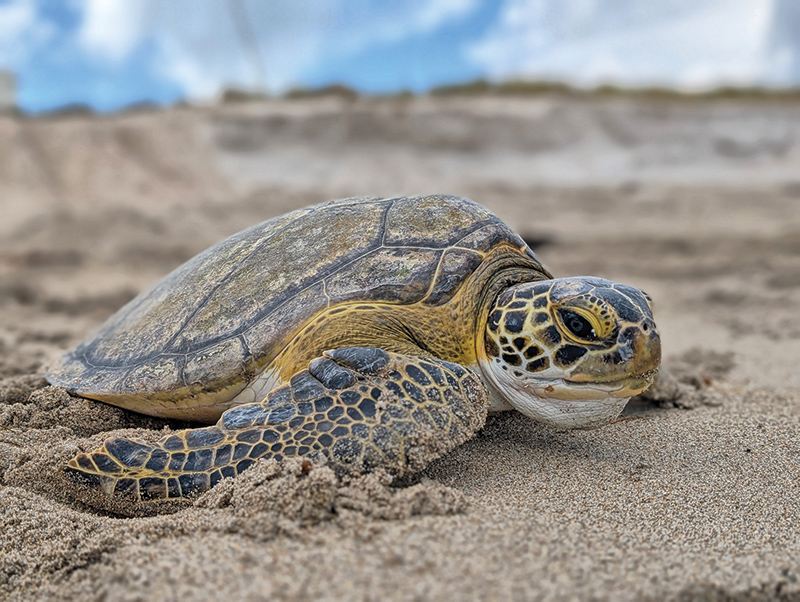
The Treasure Coast’s known biodiversity grows every day as small, dedicated teams of marine biologists pore over Atlantic habitats.
Decades of marine research in St. Lucie often include work from Florida Atlantic University’s Harbor Branch Oceanographic Institute and Ecological Associates, Inc. (EAI) of Jensen Beach. The staff of Inwater Research Group add to these insights, either at home or at sea without an office in between. “Half of the time, our office is the boat,” said biologist and spokesperson Annessia “Ness” Michaels in an Aug. 13 interview.
Inwater will enter its 25th year as a nonprofit next month. Its staff of around 20 workers adds to turtle research and conservation efforts throughout South Florida. “One of my favorite mottoes is: ‘conservation is a collaboration,’” said Michaels.
Executive Director Michael Bresette founded Inwater in the middle of a 40-year career in South Florida. Some of his most recent work includes a credit on a turtle predation study for the Journal of Animal Ecology.
Broadcasting conservation goals remains a primary concern among Inwater, Michaels said. Photos of their research – taken between the Treasure Coast, Florida Keys and Tampa – often appear on their Facebook and Instagram pages, populated by turtles and smiling biologists.
The challenges for Inwater stood before the advent of social media. The nonprofit – which began as “maybe 5 or 6 people,” according to Michaels – and these difficulties grew amid climate change and a larger population to inform.
Inwater’s small roster “allows” them to study “sea turtles in their natural environment,” Michaels said. But that scale, same as in 2001, “makes it more difficult to share our work with the community.”
“We can go out and we can study turtles in the field for as long as we want,” said Michaels. “But if we’re not relaying that information to the public, to our community, then where does it go? What do we do with it?”
A smaller staff also leads to smaller incomes. Inwater made $111,593 after expenses last year, state records show. Nearly $1.39 million, or 82 percent, of their expenses went to supporting their programs and research.
Turtle welfare and its public cache remain crucial for Michaels, who joined Inwater in 2020. The Treasure Coast, even through the COVID-19 lockdowns, appealed to her as “one of the best places in the United States to work with sea turtles,” she said. “We wanted to come out twice as strong as we had prior to that.”
But climate change – from hotter sands to tidal erosion – poses even more of a challenge. “We’ve observed these changes,” said Michaels. “Summers are getting hotter.” She added how habitat loss this way can further endanger turtles: “long-lived, late-maturing animals” that take “20 to 30 years” to reach adolescence.
“The adult population is doing really well,” Michaels said. But hatchlings may have it tougher as they become seaworthy. “It’s harder for the nests that are incubating on the beach; so, our nest success is declining.”
Upward trends, though, buoy all three turtle species studied by Florida biologists: loggerheads, leatherbacks and greens. St. Lucie reported 8,538 loggerhead nests, 571 green turtle nests and 172 leatherback nests as of July 31, according to the county’s nesting dashboard.
Said Michaels: “The good news is decades of conservation efforts have contributed to what we’re seeing and encouraging an increase in the adult population today. Florida, in the last few years, (hit) nesting records throughout the entire state.”
In the short term, that means leaving sands “clean, dark and flat” from trash, holes and light pollution. “That’s the biggest thing you’ll hear not only Inwater say,” said Michaels, which gets repeated by many Florida turtle educators.
“You gotta be ‘all in,’” Michaels said of Inwater’s work. “You gotta love these animals for many generations, and we just surround ourselves with these people who are dedicated to doing that.”
Inwater will resume their nighttime turtle walking tours next summer. They remain closed off to small groups, excluding children under 5, to prevent habitat disturbance. They will also hold a Sept. 19 fundraiser at Jensen Beach’s House of Brews, 3311 NW Main Ave., from 4 p.m. to 6 p.m.