
Budding botanists in St. Lucie have a new source of seeds for their garden: the local library.
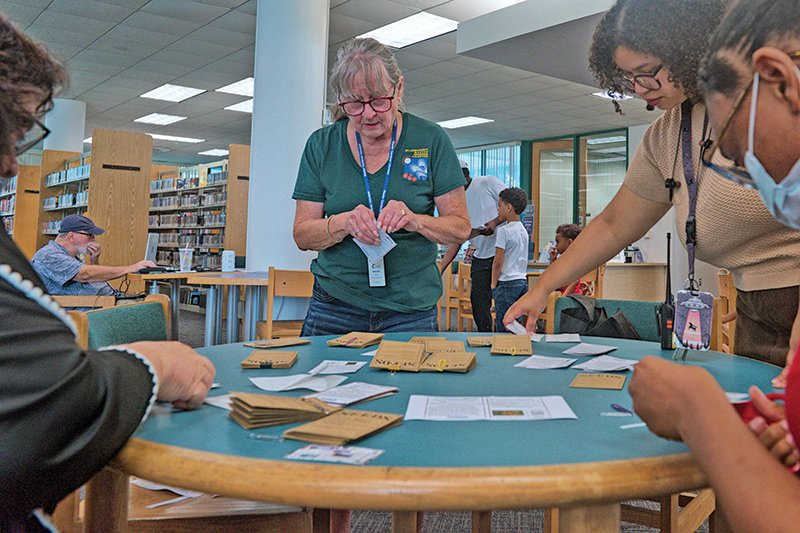
The staff of the Morningside Branch Library, 2410 SE Morningside Blvd., has become home to the county’s first-ever Seed Library, a new program that encourages responsible at-home gardening.
Sponsored by the University of Florida’s Institute of Food and Agricultural Sciences (UF/IFAS) Extension, their staff and volunteers introduced the program in front of approximately 40 attendees last Saturday.
Visitors could take home up to three packets of seeds of native plants to kickstart their greenery. They were also welcome to take home potted sunflowers and parsley.
Like with many registered through the UF/IFAS Master Gardener program, the presentation detailed the potential challenges of planting in Floridian soils.
One point of contention is the plants’ sourcing. Dr. Sara Salgado MacDonald, a UF/IFAS Urban Horticulture Agent and Volunteer Coordinator, said many uninformed plantings have introduced invasive species that soon ran beyond front yards. “It’s very expensive to get them removed once you realize they are problematic.”
The Seed Library intends to keep planters with well-kept yards using native seeds, according to MacDonald. Each packet comes with printed information and QR codes identifying their scientific name, soil suitability, and what species they might be toxic to, if eaten.
Many of these seeds are gathered by UF/IFAS volunteers, including Susan Wise, part of the Master Gardener program for five years. “We’re collecting all the time; and we usually collect them from our own yards,” she said. “There’s about 10 seeds in each packet, and there’s educational material that goes with it.”
Plant species, according to Wise, include easily domesticated “vegetables,” “mustard greens,” “herbs” and ornamental plants, like the hardy necklace pod.
Often, novice gardeners are vacationers or have moved to the area “from places north of here,” said Wise, and are unused to the predominantly sandy soils and tropical climes of Florida.
Newer homes popping up countywide may also pose a planting problem. “Another challenge is that many of the homes here are built on fill,” Wise said of more sand from construction taking up yards.
That may also complicate other soil factors, including its pH level, added Wise. Slightly acidic soils of a pH between 6 and 7 out of 14 suit planting best; pH can be tested using UF/IFAS resources.
Local gardening can also be a barometer in countywide soil health, said David Pick. A local researcher published through Indian River State College, he trained with UF in his childhood before “combating citrus greening” with the U.S. Department of Agriculture.
“We have so much native diversity that has not been tapped yet,” he said of plant life in South Florida.
Past the knowledge of yard keeping and even plant grafting among more experienced gardeners, perhaps the biggest difficulty remains “burnout,” Pick said. “People get really excited at the beginning and, then, they try to do too much. Your best bet is just to pace yourself.”