
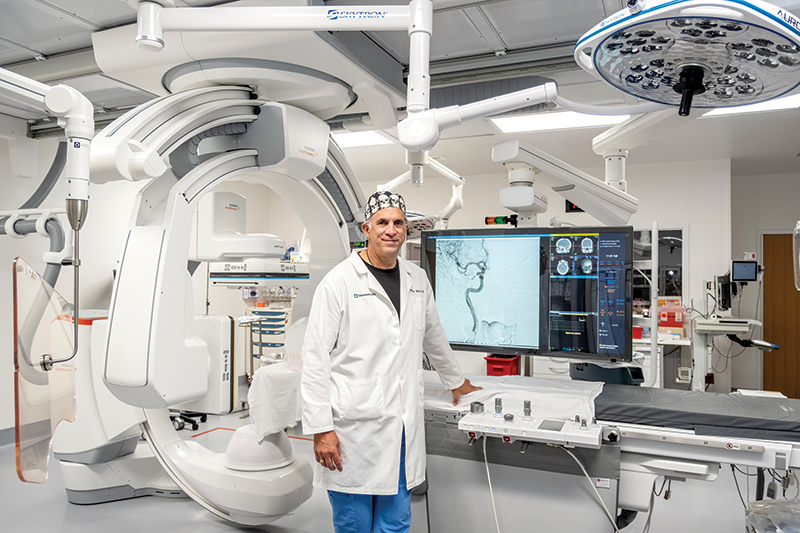
Subdural hematomas, a dangerous condition that results frequently from falls, can now be treated with an exciting new procedure that minimizes risk, shortens hospital stays, and reduces surgery time from hours to minutes.
Cleveland Clinic says a subdural hematoma is a type of bleeding inside your head. It happens when blood collects under the dura mater, the outer layer of tissue that protect your brain.
It most often happens from a head injury and can be fatal. It develops from a tear in a blood vessel when blood leaks out of the torn vessel into the space between your dura mater and your arachnoid mater (the middle layer of tissue protecting your brain).
Jeffrey Miller, M.D., whose specialties are endovascular surgery, stroke and neurology, performs this game-changing procedure – endovascular embolization – at Cleveland Clinic Tradition Hospital. He says, “Doctors don’t have to open the skull to remove the blood that pools in the brain from such an injury.”
“In endovascular embolization, surgeons treat subdural hematomas without open surgery,” he explains.
“Instead of removing part of the skull, a tiny catheter is inserted through an artery in the leg near the hip and is guided to the bleeding site in the brain. There, microscopic particles are delivered to stop the bleeding at its source.
“One of the beauties of this treatment benefits many of our senior patients who are on heart medication,” Dr. Miller continues. “In the past, they had to be off it for up to six months after treatment, but now they can go back on it almost immediately.
“Plus, they can usually go home from the hospital the next day – although, they’ll need to take it easy from five to 10 days after the procedure.”
According to recent studies published by the Society of NeuroInterventional Surgery, embolization of chronic subdural hematoma creates an opportunity for the brain to reabsorb the pooled blood while preventing re-formation at the same time.
“The chances of someone have a subdural hematoma has risen as life expectancy has increased and the activity level of today’s seniors has taken an upturn,” explains Dr. Miller.
“In the mid-1930s, life expectancy was about 55 years, now it’s into the 80s. Not only are people living longer, but their participation in sports like pickleball increases, along with the chance they’ll take a fall or get hit on the head with a ball.
“These are just the types of activities that can result in a subdural hematoma.”
ScienceDirect says that from 2020 to 2040, subdural hematoma volume is expected to increase by 78 percent, from 135,859 to 208,212 cases annually.
Most of this increase will be seen in patients 75 to 84 years old, who will experience an increase from 37,941 to 69,914, and patients older than 85 years old will experience an increase from 31,200 to 67,181.
Mayo Clinic says that after you’ve had a fall or experienced other trauma to your head, symptoms of subdural hematoma can include:
Headache that worsens.
Vomiting.
Drowsiness and gradual loss of consciousness.
Dizziness.
Confusion.
Different sized pupils.
Slurred speech.
Loss of movement/paralysis, on the opposite side of the body from the head injury.
Although risk level is low, Cleveland Clinic says that after an endovascular embolization you should call your healthcare provider if you experience:
Blood clot symptoms, which include redness or swelling in your groin.
Difficulty breathing.
Excessive bleeding.
Nausea and vomiting that make it difficult to keep food or fluids down.
Painful or fast-growing lump near the puncture site.
Signs of infections, such as fever or warmth near the treatment area.
Cleveland Clinic Tradition Hospital has been designated as an Advanced Comprehensive Stroke Center by both the Joint Commission and DNV Healthcare, two independent organizations.
Dr. Miller says, “Minimally invasive embolization for subdural hematoma is a new procedure that is still significantly evolving in regard to technique and clinical indications. We have developed a novel technique and have done extensive research, which is ongoing.”
Jeffrey Miller, M.D., specializes in endovascular surgery, stroke and neurology at Cleveland Clinic. His office is located at Tradition HealthPark Two, 10080 Southwest Innovation Way, Port St Lucie. Appointments are available by calling 877-463-2010.