
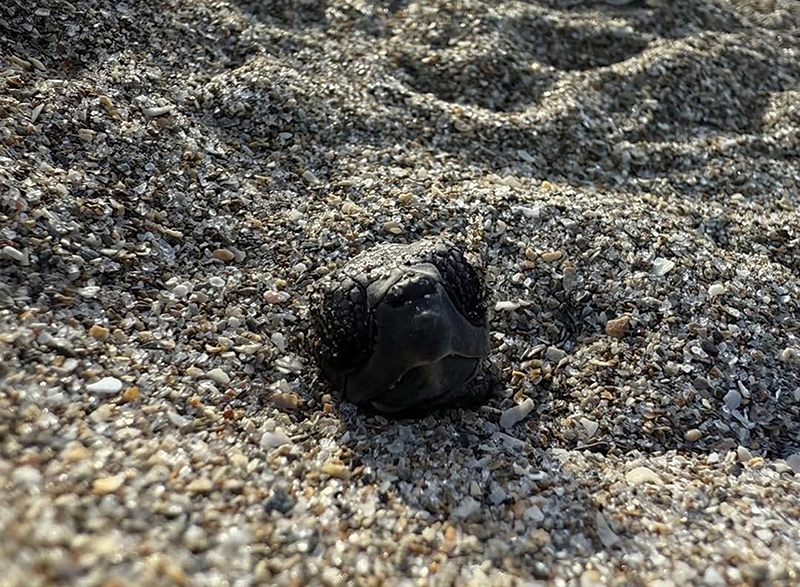
The time has come once again to dig up some fun around sea turtles, though perhaps not too far into the sandbar.
Ecological Associates, Inc. (EAI) were to begin sign-ups for a new round of early morning turtle nest excavation tours Wednesday, a county release said Friday.
Space is limited to 25 registrants for each tour, co-sponsored by the St. Lucie Environmental Resources Department (ERD), starting 6:30 a.m. every Friday throughout August. Registration for the free tours can be found at SLChikes.org. Each ticket holder may only go on one walking tour “due to high demand.”
The walks will take place on a part of South Hutchinson Island to be announced at least 24 hours before the tours begin. Visitors will begin the tour with a discussion by EAI biologists on turtle life throughout the Treasure Coast.
“Finding hatchlings is not guaranteed, but possible,” the release said. The tours will end with a walkthrough of the county ERD’s sea turtle education trailer.
In giving tours about preserving sea turtle habitats, educators emphasize a three-word slogan among coastal homeowners and beachgoers: “dark, flat and clean.”
This refers to the ideal beach environment for emerging hatchlings, wrote Lauren Maline, EAI biologist and outreach coordinator, in an email Saturday. It uses the repeated goal of limiting artificial light after 9 p.m., shoreline obstacles (e.g. sandcastles, leftover holes) and litter.
These talking points worked their way into excavation yours given last year, Maline added. EAI conducted four in St. Lucie and eight in Martin County, closer to its Jensen Beach headquarters.
Conservation may be more imperative now with a worsening climate, Maline said. More seagrass continues to wash up along Hutchinson Island due to sea rise. This causes the ocean’s wrack line, or tide-induced debris field, to wash up further inland.
Said Maline, “in some cases, we have seen hatchlings trapped in the wrack line due to the large amounts (of seagrass) along the shore. The sargassum can make it difficult for hatchlings to find the sea and make them more susceptible to predation.”
Coastal erosion from sea rise may also complicate matters. Contractors under the Army Corps of Engineers finished two major beach nourishment projects between Dollman Beach – near the Martin County Line – and the Fort Pierce Inlet as recently as June.
Northward tides eat at the 21 miles of shores biologists scour for turtle nests, much of which is classed as “critically eroded,” Army Corps records show.
Further nourishment projects will bolster these beaches “to protect adjacent infrastructure,” wrote St. Lucie County communications director Erick Gill in a July 7 email.
Jetty Park, just south of the Fort Pierce Inlet, will continue receiving new sand every two years, according to Gill. An emergency nourishment occurred there weeks before a planned effort from March to June. Waters have already carved new escarpments along these beaches.
Dollman Beach, like shores closer to the Martin County line, remain “on a federal nourishment schedule of 18 years,” wrote Gill. Both nourishment timelines may be expedited to address “storm impacts,” should they arise.
Hatching season continues apace among the three most commonly tracked turtle species, according to the county nesting dashboard. Biologists found 7,149 loggerhead turtle nests as of June 30, already on par with the 7,356 thereof found last year.
Leatherback nests trended similarly, with 228 nests found compared to last year’s 287. Green turtles lagged this year after a productive 2025, with 195 nests so far. The resurgence of a two-year mating cycle resulted in a peak 1,506 nests last year.