
Welcomed showers continued to pelt St. Lucie recently as the county recovers from severe drought brought on by the February cold.
Record rainfall of 1.28 inches fell on the county March 29 and 0.2 inches fell April 3, according to the National Weather Service. These totals arrived in between readings that rarely rose above 0.5 inches the weeks of March 22-April 4.
The CoCoRaHS volunteer weather monitoring service reported similar peaks centered around White City and Tradition. Three readouts between these sites took in anywhere between 1.34 to 1.81 inches of rain, according to the CoCoRaHS website.
Smaller peaks descended on the same areas April 3; the same sites recorded between 0.69 and 0.92 inches when rain fell the prior evening. Another 0.36 to 0.56 inches fell the evening of April 4, according to readouts the following day.
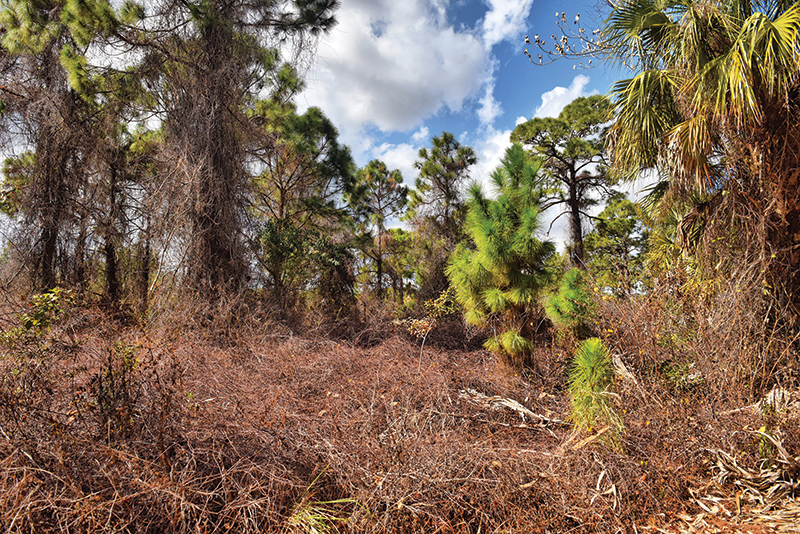
Plants killed by extreme drought and frost in previous months remain as county soils absorb needed water and green hues return to vegetation that survived.
To accommodate their disposal, Port St. Lucie began collecting higher totals of residential plant waste the week of March 30-April 2. The city increased their cap of yard waste in weekly pickups from 4 to 6 cubic yards per household, city releases say.
Port St. Lucie did not provide a volume of yard waste collected last week by press time.
Drought also continues to recede slowly in the unincorporated county. The Florida Forest Service recorded wavering Keetch-Byram Drought Indices (KBDI) as rain refreshed coastal and rural land alike.
St. Lucie’s average KBDI fell to 471 out of 800 on April 3, from “extreme” to “moderate” drought conditions, Forestry records show. These numbers are a far cry from the emergency measures the county Fire District took to discourage brush fires, including a 41-day recreational burn ban from Feb. 7-March 20.
Prescribed agricultural and silvicultural (habitat control) burns continued apace throughout the drought, according to Forestry wildfire mitigation specialist David Grubich in an April 1 email.
Forestry approved 152 prescribed burns across 2,650 acres using 291 tinder piles. As with the rest of Florida, Forestry approves “open burn authorizations” in St. Lucie “daily based on the conditions” surrounding the land, wrote Grubich.
Fires to refresh carbon content in pasture soils took up the greatest acreage. A total of 19 burns occurred throughout 1,190 acres (44.9 percent) using 48 approved tinder piles. An undisclosed acreage of citrus groves made up the greatest number of burns and tinder piles; 64 burns (42.1 percent) were conducted with 120 (41.2 percent) tinder piles.
Three “ecological” fires took up 880 acres (33.2 percent) using an undisclosed number of piles. Agricultural “range management” burns make up 13 fires across 580 acres using 8 piles.
Other burns without any disclosed acreage include 46 “non-residential” fires using 105 piles; and seven “residential” burns with 10 piles.
Forestry also logged 14 brush fires in St. Lucie this year. Two of them reached Class 2, where their area engulfed between 6 and 50 acres. These included a 23.8-acre fire along South Brocksmith Road in inland Fort Pierce Feb. 9; and a 10-acre fire near Indian River Estates Feb. 25.
The record frost surrounding St. Lucie’s incredibly dry winter concerned Grubich, who reported on the containment of brush fires like the 700-acre Long Bay Fire in May 2024, ahead of his retirement this August.
“In my 12 years with the department, this has been the worst drought I can remember,” Grubich wrote. “On top of that, there were three cold spells resulting in significant frost kills.”