
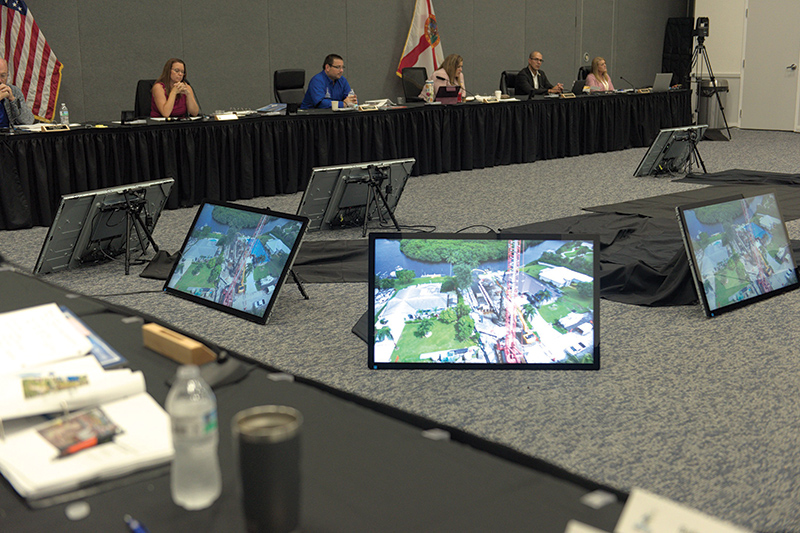
For two days, uncertainty weighed on the Port St. Lucie City Council as they discussed a budget they hope will alleviate continued money woes as St. Lucie keeps growing.
The 2026 City Council Summer Workshop, held July 22-23, scrutinized a proposed budget of, at most, $975.2 million for the next fiscal year. As with 2025, city leaders developed the budget to counter rising costs from tariffs and inflation since last year.
To that end, the council approved decreasing millage by another 10 cents taxed for every $1,000 in home value. Homeowners will now pay a rate of $4.88 opposed to $4.97 next year, the latest in 11 straight years of millage reductions.
Homeowners will also see a flat $14.83 increase on solid waste disposal, taxing a year-end $482.16 per home. Those living here before 2021 will see a $364 refund; and those living here since 2022 a $64 refund in their tax bills after a $24 million settlement with WastePro, city records show.
Other fees agreed upon include a 3.5 percent rate hike on tap water, though no increase on sewer rates; and a flat $6 increase on stormwater rates to $195 for furnished lots and $147.75 for vacant lots.
Population growth continues to cool after peaking in the direct aftermath of the COVID-19 pandemic. But that hasn’t stopped Port St. Lucie from having to onboard many new moves in one of Florida’s 10 fastest-growing counties, according to the U.S. Census Bureau.
Ballot Amendment 3, also known as the “Save Our Homes from Excessive Property Taxes” measure, entered the conversation in this year’s workshop as another step intended to excise property taxes from Florida altogether.
Amendment 3 is intended to greatly increase taxation caps on homes that applied for protection under the Homestead Act. On paper, it protects homeowners from property tax increases assessed by the value of their home when they move in.
The amendment would raise the Homestead exemption on properties, except for schools, from $25,000 to $150,000 next year; and to $250,000 by 2028, state documents say. It would also reduce the tax cap on non-homesteaded properties from 10 percent to 5 percent along with curtailing municipal spending.
If passed, Amendment 3 could cut the city’s property tax, or ad valorem, revenue by significant margins. Port St. Lucie could lose as much as $60.7 million in revenue by the 2032 fiscal year, according to the Florida Policy Institute. Those losses will accumulate from an initial $28.1 million next year to $45.5 million FY 2028-29 before cooling in between.
St. Lucie County, the Institute added, could lose up to $276 million in its first year of enactment.
The prospect of Amendment 3 brought unease to the City Council, still unsure of what could happen if three-fifths of voters approved of it come November. Those who supported or opposed Amendment 3 recognized it could cost local governments much in the long run.
It was what Vice Mayor Jolien Caraballo called, on July 22, “waiting for the inevitable.”
“If it was to pass, we would have to make very hard decisions next year,” said Caraballo. “But, I would rather deal with the certainty of that than not make a decision that I know is right for the uncertainty of today.”
“This is like déjà vu for me,” said council member Anthony Bonna Sr.
Bonna, a state legislative hopeful who will leave the council next year, spoke of his time as a county commissioner. He felt he didn’t do enough to support a previous Homestead Act increase in 2018.
State Amendment 1, which promised to raise exemptions fourfold, died after 58 percent of voters supported the measure, just under the 60 percent needed for legislation to pass in Florida since 2006, records show.
“There was uncertainty on the future of the sales tax,” Bonna said. Other funding demands produced “a very stressful environment” for St. Lucie, which, same as in 2018, still has the highest aggregate millage rate (today, being $7.99 per every $1,000 in home value) among the state’s 67 counties.
Added Bonna: “It was, honestly, one of the biggest regrets I had.”
Much of the new budget will continue to fund a bevy of utility and infrastructure projects. Some of them still use funds from the American Rescue Plan Act (ARPA) enacted by President Joe Biden in 2021.
But the funds once available through ARPA have since dwindled, and actions during the second Trump administration brought unprecedented inflation through foreign tariffs and, as of February, war in Iran.
Federal decision-making, along with state cuts, continues to trickle down to St. Lucie, which has incurred patterns of “exorbitant growth” since the COVID-19 pandemic, said Mayor Shannon Martin.
“The costs are still much higher than we expect,” Martin said. She referred to fluctuating costs that have hampered the construction market for the city with ongoing increases since last year. “Unfortunately, they are going to continue to escalate.”