
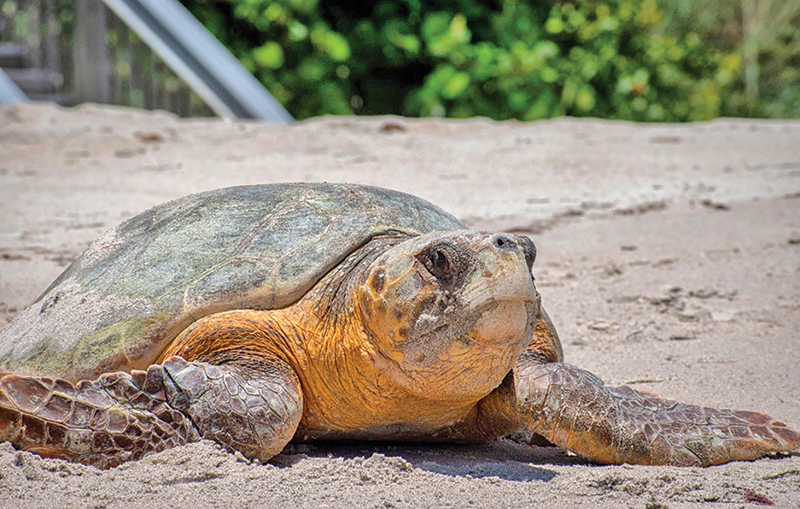
Local beachgoers will get another chance to see sea turtles nesting through a new round of nighttime walks that began Tuesday despite the resurgence of extreme weather issues.
Ecological Associates, Inc. (EAI) kicked off the first pair of eight nighttime walks to take place every Tuesday and Wednesday in June. The Jensen Beach-based marine biology firm has given the tours for years as they continue to survey turtle nests on St. Lucie’s barrier island beaches.
Free tickets for up to 25 walkers can be found at St. Lucie County’s Guided Nature Programs page: stlucieco.gov/departments-and-services/environmental-resources/guided-nature-programs. The Tuesday tours filled to capacity while Wednesdays remained open as of May 27, according to EAI biologist and outreach coordinator Lauren Maline.
Each tour will begin with a head count and presentation at the Jensen Beach Community Center, 1912 NE Jensen Beach Blvd., at 9 p.m. From there, tourists were to be guided to “a new location” along South Hutchinson Island to find a “suitable nest” for the remaining walks, according to the St. Lucie website.
As in past years, EAI’s tours adhere to strict requirements from the Florida Fish and Wildlife Conservation Commission (FWC), Maline said. She and her colleagues spend weeks before and during the walks informing tourists and coastal homeowners of preventing man-made obstacles like excess lighting and leftover sandcastles that could threaten turtle health.
“Most of these requirements are listed on the registration pages for the events,” Maline said. She added EAI staff also “constantly remind” walkers up to the tour itself between registration emails and the opening presentation.
While the program offers “no guarantee” that visitors will spot a turtle, according to the St. Lucie website, the nighttime walks continue to offer visitors the chance of seeing a mother turtle laying eggs.
The absence of a nesting turtle on the walks “only happened a handful of times,” said Maline. She added these lulls mostly happened during July, which led EAI to limit the walks to June.
Like any outdoor program, the walks are weather permitting, Maline said. “We have had to cancel a few events due to the weather; although we do go out rain or shine, we will postpone or cancel if there is lightning due to safety.”
This year’s round of nighttime sea turtle walks faces more climatological uncertainties. Hotter temperatures and roving sargassum, or seagrass, patches that killed at least one turtle near the Fort Pierce Inlet impose greater risk for hatchlings in Hutchinson Island dunes.
EAI, which St. Lucie subcontracts every hatching season March through October, found 734 nests along Hutchinson Island as of May 27, according to biologist Chelsey Petersen. All of them belong to loggerhead turtles, one of three survey species documented in St. Lucie and Florida.
“The sargassum should not impact our turtle walks,” Maline said. She added, though, that beaches affected by “extreme sargassum wash-up” can “reduce” habitats for mother turtles.
“Most of the time, nesting females are able to crawl farther up the beach or find more suitable nesting beach nearby,” Maline said. Excess seagrass can exhaust hatchlings and leave them “dehydrated” like man-made obstacles she and her colleagues discourage the presence of.
In addition to new mats of seagrass, hatchlings are also susceptible to natural threats including flooding from high tides and storms along with “predation” by other animals and “natural diseases,” Maline said. She added that beachgoers who spot trapped or infirm hatchlings can notify the FWC hotline at 888-404-3922.