
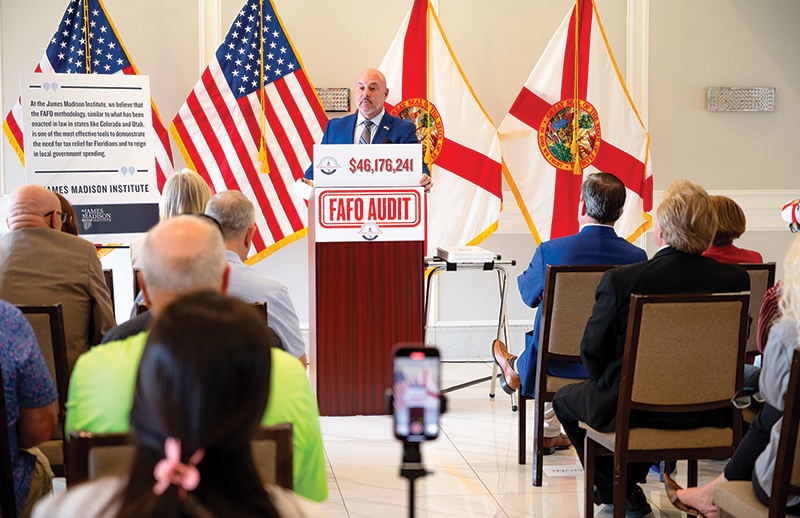
The state of Florida’s Chief Financial Officer Blaise Ingoglia paid a visit to St. Lucie County last week, and his message to the community was … you’ve been ripped off.
According to Ingoglia, St. Lucie has wastefully spent more than $46 million of taxpayer money. Earlier this year, he told the City of Fort Pierce that $10.5 million was overspent and wasted.
“Government is expanding because they can, not because they need to,” said Ingoglia. “They continue to cry the same thing: poor, poor, poor.
“I made it my mission to advocate for taxpayers. Taxpayers are the ones who get the short end of the stick,” he said.
According to the CFO, the general fund increased by about $123 million, or 76 percent, since 2019. He said that the county hired 212 new full-time employees since 2019 as St. Lucie grew by over 72,000 residents, and pointed out that out of the 212 employees, only 22 were added to the Sheriff’s Department.
“St. Lucie County is committed to responsible stewardship of taxpayer dollars and to providing essential services that protect public safety, maintain infrastructure and support the quality of life our residents expect and deserve,” said Erick Gill, St. Lucie County’s director of communications.
“We welcome constructive dialogue about government accountability and remain confident in the integrity of the county’s financial management. We have asked the CFO’s Office to provide a detailed spreadsheet showing how today’s numbers were derived. We don’t disagree with the methodology, but we do question where some of the numbers and figures came from.
“As an example, CFO Ingoglia claimed that the Board of County Commissioners added more than 200 employees in the past five years, yet our budget books show an increase of roughly 130 new employees. Even with the additional employees, the Board of County Commissioners employee count is still less than it was in 2007, while today’s residential population is more than 140,000 additional residents,” Gill continued.
During the press conference, Ingoglia cited numbers from many counties and cities in the state, regardless of political affiliation. “I’m trying to prove I don’t care if you’re red or you’re blue,” he said.
“Across 17 local government spending reviews, we have seen bloated budgets and excessive spending become the standard for local government bureaucrats. The residents of St. Lucie County deserve for their elected officials to demonstrate fiscal restraint, but sadly, that is lacking in this local government. I will continue to uphold my responsibility as an advocate for the taxpayers and work so that Floridians see real property tax relief,” he said.
The CFO said he has uncovered over $2.1 billion in excessive and wasteful spending in the general-fund budgets of 17 local governments over the past two fiscal years, and plans to continue his work exposing what he calls wasteful spending.
Ingoglia uses the Florida Agency of Fiscal Oversight (FAFO) method to determine wasteful spending. He began with fiscal year 2019-2020, the last budget pre-COVID. “We find what it was then and index it forward to see what it would be now,” he said, adding that population growth is factored in. “What would it reasonably be today, then calculate extra population.
“St. Lucie County blew past that number by a relatively large amount,” he said of the $46 million wasteful-spending figure. “This is the amount of money that we think they were overtaxed. This government saw all the extra money and never gave it back to the taxpayers.”
According to Ingoglia, the county could have cut property tax bills by 1.04 mills, meaning a home with an appraised value of $300,000 would save $312 per year and a home valued at $400,000 would save $416. He says the cut would not impact any essential services. “They can cut just over a mill and not feel it,” he said.
St. Lucie County, meanwhile, stands by its budgeting methods. “County staff follows established budgeting and accounting processes as well as annual independent financial audits. These processes ensure transparency, accountability and compliance with all applicable state and federal requirements,” Gill said.
“The Board of County Commissioners’ budgets are developed through a public process that includes multiple advertised public hearings, oversight by elected commissioners, opportunities for community input and continuous review by a citizen’s budget committee, made up of local residents and taxpayers.”