
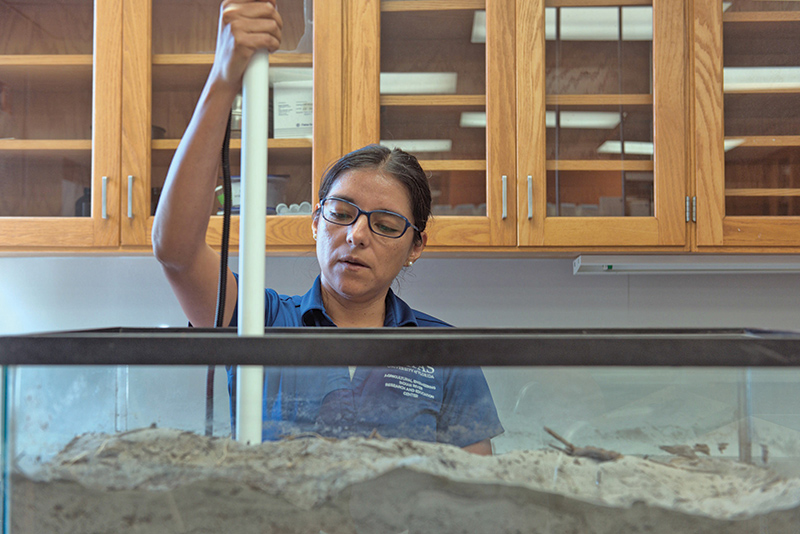
A seven-year study to refine agricultural watering brought national award recognition to a St. Lucie-based researcher with the University of Florida.
Dr. Sandra Guzmán, an assistant professor with UF’s Institute of Food and Agricultural Sciences (UF/IFAS), received the Netafim Award from the American Society of Agricultural and Biological Engineers, according to an April 30 release. She will accept the award in a ceremony in Indianapolis in July.
Netafim, a manufacturer of irrigation equipment, honored Guzmán for her research on IrrigMonitor: a software suite made to refine crop hydration using weather monitoring and soil moisture readouts.
The use of IrrigMonitor has spread to five crop producers in Florida, including two in St. Lucie as of press time, said Guzmán in a May 8 interview. She could not identify any of them due to non-disclosure agreements. Its adoption during the COVID-19 pandemic has led to “reduced labor in the farm.”
“It’s very hard to get an automation system right away,” due to their expense, Guzmán said. “We can give them the technology, but (it) really has to be ready for them to utilize.” She added: “The shift is, for sure, moving into the future generation of farming.”
IrrigMonitor is central to Guzmán’s work at the UF/IFAS Indian River Research and Education Center since November 2018. Effective watering has long been challenged by adverse conditions affecting arable soil, including months of drought and record cold in February St. Lucie continues to recover from.
“This is the busiest time of the year for us,” Guzmán said, adding the recent drought left little freshwater to pour in from sources like Lake Okeechobee. “When that happens, growers in the area may have to rely on groundwater sources for irrigation instead of surface water. (St. Lucie) irrigates with surface water.
“People may think we have excessive water,” Guzmán said, “but it turns out that for periods like right now, we may have a deficit of water. The main question was how we can improve water use efficiency and make sure that every single drop of water that goes into the field becomes food.
“There are many challenges with that,” Guzmán said. One of them is identifying what happens to water that gets absorbed into soil. IrrigMonitor, she added, allows growers to observe where water goes into land through its moisture sensor suite.
The second challenge arises with crops, predominantly citrus fruit and vegetables, that cannot absorb water “efficiently through the root system,” Guzmán said. That gets compounded by St. Lucie’s sandy soil which lets water – usually filled with salt and mineral content – leach past root systems and drain into canals to the Indian River Lagoon.
“The goal with smart irrigation is to prevent all of that water (from moving) into that layer of soil so the water keeps moving horizontally,” Guzmán said. She added the system can also transmit water vertically “at shorter frequencies.”
“We start saying, ‘OK: There is a drop of water, it’s moving through the soil,’” Guzmán said. “Now, we can target that drop of water to be in the root system (and not) other systems,” like the canals.
Automating those systems fell to researchers like Dr. Gregory Conde, who worked with UF/IFAS for three years. He has long associated with Guzmán on programming software for moisture sensors and weather readings to give farmers the best guidance for watering.
Programming IrrigMonitor “can combine physics with data,” Conde said. His work employs a two-part distribution of information between farmer and machine, sometimes using artificial intelligence and deep learning to better regulate how often and how much water goes into a field.
According to Conde, scores of sensor data throughout the seven-year trial period are stored in cloud drives. Giving computer data in bulk to IrrigMonitor can translate into watering by the hour or day depending on a farmer’s needs and “produce better” produce. “We can provide that technology that is simple for the growers that is easy to use,” Conde said. “Now, with our technology, we are providing simplified instructions,” that growers wouldn’t “require a Ph.D.” to operate.
That ease of access can rid the toil of farming for future farmers, Conde said. “With the time that we are learning more about the nation, we know that we need to make an optimal production (including) tools to solve that kind of problem.”