
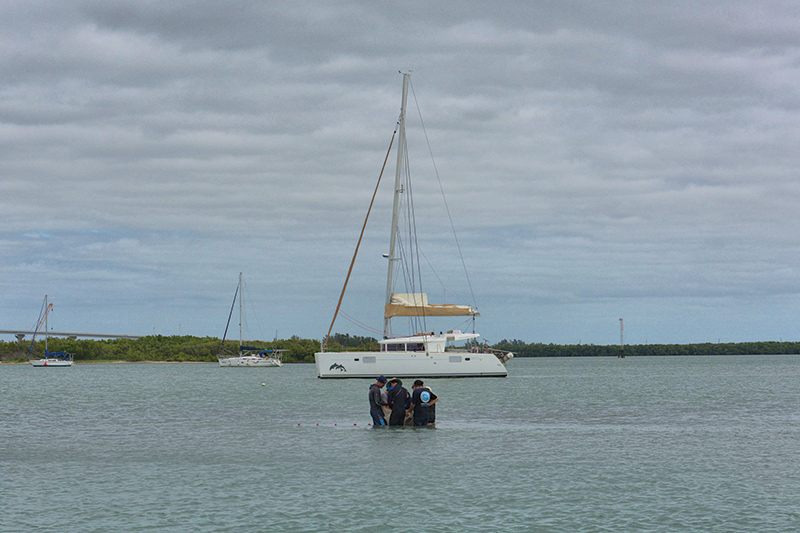
Healthy beaches and waters are full of life, most of it invisible to the naked eye and swarming under our feet, marine biologist Dr. Holly Sweat said April 15.
The St. Lucie County Aquarium, 420 Seaway Dr., held their last of four morning lectures of 2026 given by staff of the neighboring Smithsonian Marine Station. Sweat, director of their Benthic Ecology Laboratory, presented research on microorganisms to round out the season’s talks on aquatic habitats.
Like her fellow presenters, Sweat discussed habitat health and rehabilitation. She spoke about how microscopic organisms, like plankton, can be barometers of a watery biome’s well-being.
Sweat made her case in front of approximately 25 scientists and seafarers using data from waters connecting Lake Okeechobee to the Indian River Lagoon and Atlantic Ocean that her team compiled in quarterly assays between 2005-2022.
She adorned her presentation with allusions to films that invoked marine biology: from the sense of scale creatures smaller than us can see in “Honey, I Shrunk the Kids,” to the otherworldly anatomies H.R. Giger sculpted in Ridley Scott’s titular “Alien.”
These studies compiled a taxonomy of at least 675 minuscule species between the lagoon and barrier beaches, Sweat said. On average, around 8,690 organisms can lie under the average person’s foot during a walk on the beach.
“We really tend to focus on these organisms because they are worldwide indicators of environmental change,” Sweat said. “We can collect these, we can learn about their tolerances (and) that tells us how healthy the surrounding environment is.”
Sweat’s team studied waters in St. Lucie influenced by statewide land speculation since the late 1800s. The buildout of new communities and farmland led to the “advanced system of canals” that they rely on today for drainage, she said.
Today, the St. Lucie River is one of the two largest thoroughfares of this drainage along with the Loxahatchee River flowing out west, according to Sweat. More freshwater from inland can dilute the salt content – or salinity – of Lagoon and Atlantic waters, along with introducing more pollutants and sediment.
“They cause more algae blooms, (more) fish kills and overall habitat degradation,” Sweat said. “You could imagine, especially after a hurricane or (a) rainy season, that these large volumes of freshwater are going to wreak havoc in marine environments.”
This flow could be redefined through the Comprehensive Everglades Restoration Plan by the U.S. Army Corps of Engineers in the coming decades. The “monster effort,” Sweat said of the federal multi-agency project that began in 2000, intends to “return a more natural water flow to the Florida peninsula while not drowning out all the people that live here in homes and farms.”
She and her team used the “Infaunal Report Card,” a letter grade system to determine water quality defined by the Army Corps. They monitored 15 sites between the St. Lucie River and Indian River Lagoon with these guidelines.
Most sites in the Lagoon scored “A” and “B” grades within these criteria, while those further inland scored consistent “D” and “F” grades.
Three sites in the mouth of the river provided the clearest picture of this gradient. According to Sweat, the site farthest inland scored the highest “F” grades as researchers routinely noted the presence of black riverbed “muck” and the “rotten egg” stench of hydrogen sulfide deposits.
The muck’s composition, which would require further study beyond Sweat’s scope, consisted mainly of decaying organic matter. Rotting material, like dead plants, would attract nitrogen and heavy metals in the absence of oxygen.
“We have a nasty bottom right at the end of downtown Stuart,” Sweat said. “Most things can’t live there.”
The team also logged “eight hypoxic events” where accumulated waste depleted oxygen and threatened local wildlife both “weedy” and delicate, Sweat said. “If we were to go out weekly or daily, we’d see a lot more.”
“All of that puts a similar stress on the ecosystem,” Sweat said, adding how extreme weather like rain and drought can produce these outcomes. “There’s going to be tolerant species (while) those events are going to kill off all the sensitive ones.”
By contrast, the other two sites showed between a robust “shell hash” and seagrass with far less hydrogen sulfide and one hypoxic event between them both, Sweat said.
“You see from this how the Infaunal Report Card works really well to mirror the overall health of these different ecosystems,” Sweat said.