
Port St. Lucie has a renewed sense of purpose in building and maximizing its city-owned green spaces.
A 2.4-acre patch of trees in the Whispering Pines community served as the pilot for what some public land managed by the Naturally PSL program could look like in the coming years.
The plat – encircled by SW Hiawatha Street; SW Homeland Road; and SW Lovell Terrace – had, for decades, remained a dormant habitat as new homes were built nearby.
Around 20 city workers and volunteers met there the morning of March 21 for two purposes: to plan another park, and to promote the growth of its native biota before marking trails and public amenities.
The demonstration gave a precedent for building amenities, including “a rustic, low-impact nature trail,” for a growing collection of city-owned green spaces, according to a March 11 release.
Volunteers that morning represented a cross-section of several city-led opportunities formed in recent years: from the Youth Council to Love Your Block, the latter being part of Naturally PSL.
The first step in beautifying the plat was the release of insects led by Dr. Carey Minteer, director of the Minteer Biological Control of Weeds Lab with the University of Florida Institute of Food and Agricultural Sciences (UF/IFAS).
Volunteers and research aides spread bugs, including the air potato beetle (lilioceris cheni) and the Brazilian pepper thrip (Pesudophilothrips ichini), to weaken invasive plants within the property before contractors can remove them.
“The beetles and thrips hang out here,” Minteer said as the group spread the bugs on invasive foliage. “They’re going to take care of some of those (plants) that aren’t going to be taken out by the city’s contractors.”
Making “very healthy” habitats bolstered by native plants through insect release, Minteer said, can also reduce “competition” in natural areas and avoid hazardous herbicide use.
Air potato beetles marched out of balls of sand with burnt orange carapaces onto gangly, aging vines choking the forest floor. Higher up, thrips ate into Brazilian pepper trees with telltale bright-red berries. “The thrips will take several years to (consume) large plants,” Minteer said.
One volunteer, Sheila Taylor, spread thrips onto pepper tree leaves from a paper towel. The insects waded into the leaves like they were “a sirloin steak to them,” she said.
Taylor, a 22-year Port St. Lucie resident and Love Your Block volunteer, spent the rest of the morning picking litter while discussing what lay in store for other natural plats.
The city would avoid using “fertilizers or anything that would kill our animals” to beautify these spaces, Taylor said, referring to Love Your Block’s talks with Port St. Lucie officials on these spaces.
“I imagine that they have discussed that between them.”
At a house along the northern perimeter, Joseph A. Robert spent his morning mowing the lawn. New discussions over the city’s use for the Hiawatha plat, which seldom existed in the 22 years Robert lived in the city, piqued his curiosity.
Robert said the city “would build no houses” on the property throughout the time he lived there. “For 22 years, it’s been what it is.”
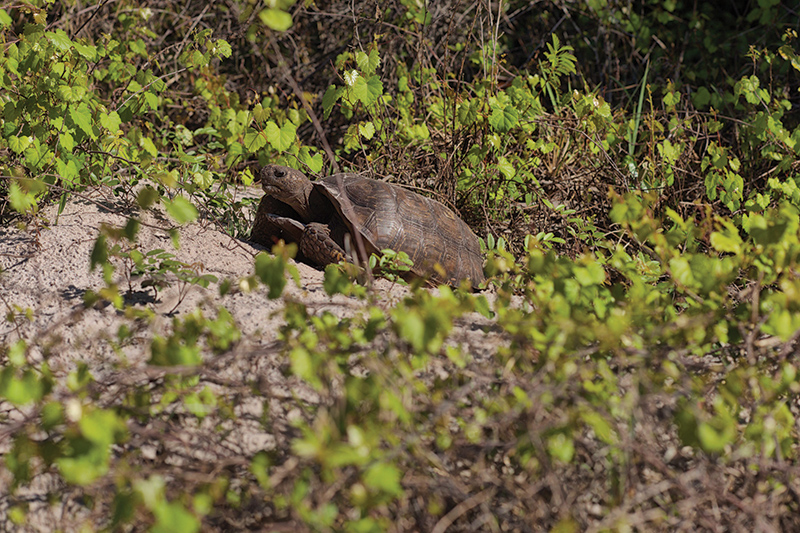
The plat was home to animals including a “family of foxes” that sometimes emerged to forage trash as the community grew. They came less often, however, when Robert’s neighbors brought home dogs. “Everybody started having dogs, so they just started to disappear.”
Like many areas that grew over time, the plat reckoned with litter and residential debris. Robert recalled an episode of someone “bringing sofas and couches back there,” which he cracked down on personally.
With insect control and litter tended to, city officials pointed out what could become of the plat over time, from benches and swing sets to a trail network.
They were joined by Kyle Brooker, a co-owner of Sampson Tree Services. Port St. Lucie tapped his company, among others, for various public space projects that needed invasive plant removal.
Beautification, such as with the Hiawatha plat, circulated in a “large conversation” with the city’s Parks & Recreation Department spanning two years, Brooker said. “I’m pretty sure since before they brought me in, there were already discussions that were moving around in the departments about what to do with land owned by the city; and trying not to develop but to preserve.”
By noon, deputy city manager Kate Parmelee conferred with Brooker on how to discuss further work on the plat. She had surveyed the plat earlier, spotting potential amenities with Nikki Zheng, a consultant fellow with the Bloomberg Harvard City Leadership Initiative.
Their chat concerned Sampson’s potential operations there, for the time being restricted to manual machete cutting. The item was to be sent to the City Council for their March 23 regular meeting.
“We want to balance it between manicured and maintained”, Brooker said to Parmelee. “We take strong considerations on what it is and what it isn’t.”
“This is public land,” Parmelee said, “but people don’t often see that as (such).”