
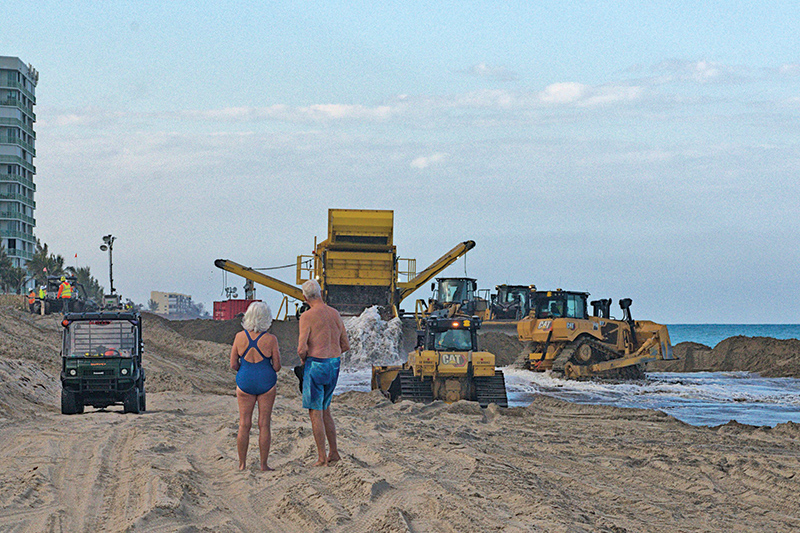
Escarpments along South Hutchinson Island beaches continue to reach dangerous heights as shoreline erosion cuts off visitor access to the Atlantic.
Nowhere could that be seen more evidently than between Jetty Park and South Beach, where erosion forced Fort Pierce to declare a state of emergency between Feb. 11-20. By then, the sands stood nearly 10 feet above the shoreline, their strata visible to visitors braving the nearby rocks to wade in the water.
Workers from Dickerson Infrastructure moved at least 10,000 cubic yards of new sand purchased by St. Lucie County to afflicted beaches over the past two weeks, according to county communications director Erick Gill. By that point, the Atlantic had eaten away at beaches “just south of the jetty,” leaving waters there a sickly tan as opposed to the haler blue of the Fort Pierce Inlet.
The City of Fort Pierce also incorporated an unspecified portion of sand bought with their own funds, according to county communications manager Flynn Fidgeon. The city did not specify how much sand they purchased nor the cost thereof by press time.
The emergency re-nourishment necessitated at Jetty Park preceded a scheduled biennial restoration of sand conducted by contractors using funding from the U.S. Army Corps of Engineers.
Approximately 400,000 cubic yards of sand will arrive at the Fort Pierce Inlet starting March 10, according to J.P. Rebello, public affairs officer for the Army Corps Jacksonville District. He added the Army Corps approved a contract for the project on Sept. 25.
Fidgeon said the permitting there will skirt sea turtle nesting windows that will allow the project to continue until May 30.
South Beach and other coastlines near the Fort Pierce Inlet continue to erode at unchecked rates amid rising sea levels and inclement weather, with multiple re-nutrition projects having taken place since Hurricanes Ian and Nicole impacted St. Lucie in late 2022.
The Army Corps, over nearly four years, has invested upwards of $38 million toward beach renourishment projects along South Hutchinson Island, wrote Rebello in a Feb. 20 email. Approximately $16 million came from the Flood Control and Coastal Emergencies Program to cover these projects in full.
“Impacts from Hurricane Nicole ultimately resulted in rehabilitation funding from the federal government,” Fidgeon said of the funding behind this restoration.
The geography of the Fort Pierce Inlet, according to Fidgeon, factors into how ocean waves can unfavorably break into Jetty Park and South Beach to further aggravate erosion.
“Escarpments typically happen after high wave conditions. In most locations, these features resolve themselves when wave conditions relax,” Fidgeon said.
“The inlet severely limits the amount of sand reaching this beach, and as a result, we have to nourish this beach frequently to ensure that the coastal system is healthy.
“Areas immediately downdrift of the inlet experience chronic erosion and the escarpments can last for long durations of time,” Fidgeon added.
Waterfront businesses and homes taking advantage of beachfront property along the barrier island remain at risk from continuing sea rise and storm activity throughout the Caribbean and Southeast Florida. One such place, the Island Beach Bar and Restaurant, 110 S. Ocean Dr., saw this erosion firsthand as the Atlantic washed away walkways near Jetty Park.
Jennifer Cranwell, an assistant manager at Island Beach, recounted how the state of emergency progressed in a Feb. 18 interview. Her home and business, both on South Hutchinson Island, has experienced troubling activity tied to beachfront erosion over the years.
“This year, in particular, seems to be making an impact as far as (escarpments) coming up as far as it has versus years past,” Cranwell said.
“I have not, personally, been impacted, but the community I live in, however, I do hear of several properties that the erosion has impacted,” Cranwell said. “It has come up to their decks and taken out some of their shoreline property.”
With the latest round of beach renourishment slated for mid-March, Cranwell hopes that the county and Army Corps can “better leverage and prepare unforeseen weather conditions” that may yet aggravate erosion further, she said. “We know that this is the common denominator.”
The latest re-nourishment project, like many such projects, will utilize federal funding as St. Lucie organizations seek “long-term solutions” to fortify South Hutchinson shores, Gill wrote in a Feb. 18 email.
The shores of the barrier island are separated into three segments based on their vulnerability to ocean activity, according to Florida Department of Environmental Protection surveys made last August. They continue to dissolve into the ocean in miles-long portions, especially since late 2022.
FDEP, state records show, designated 7.6 miles of South Hutchinson shores grouped into three “critically eroded” beaches: Fort Pierce Beach between Jetty Park and South Beach (2.3 miles); Walton Rocks Park near the FPL Nuclear Power Plant (1.9 miles); and the southernmost beaches between Dollman Beach and the Martin/St. Lucie county line (3.4 miles). “Non-critically” eroded areas make up the 7.9-mile remainder of the barrier island.
The Army Corps continues another beach renourishment project at Dollman Beach. This portion uses $14.7 million toward dredging and the incorporation of 250,000 cubic yards of sand mined from St. Lucie Shoals found 3.5 miles east in the Atlantic, federal records show.