
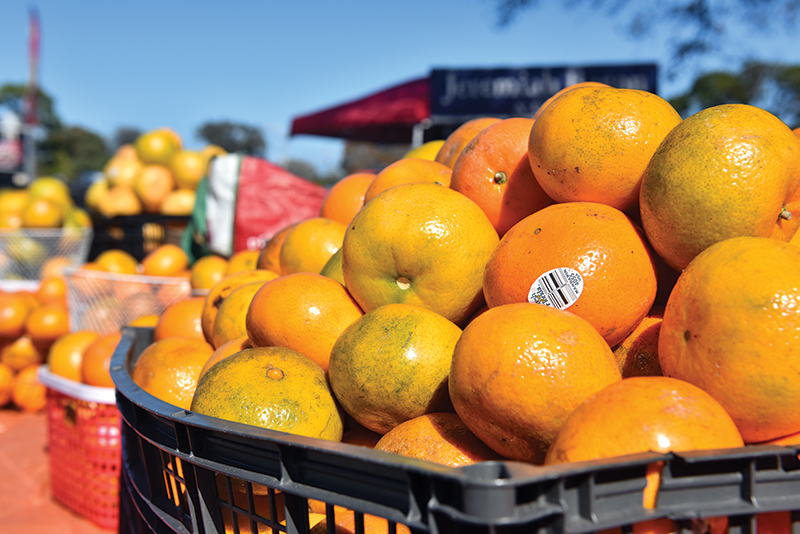
Recent U.S. Department of Agriculture studies show strides toward the development of cit-rus trees resistant to a disease plaguing groves throughout St. Lucie and Florida since the mid-2000s.
Researchers at the USDA Horticultural Research Laboratory in Fort Pierce published studies last year that have lent further insight into breeding groves that can withstand Greening, a bacterial disease afflicting citrus crops first discovered around 2005.
The Hort Lab developed at least “two citrus cultivars with tolerance to” Huanglongbing (HLB), the insect-borne bacterium responsible for Greening, research director Dr. Scott Ad-kins wrote in a Jan. 29 email.
According to Adkins, these two varieties of orange – codenamed “Brixy” and “SunGlo” – both display traits that make them “useful to commercially blend into orange juice” even if infected with Greening. “SunGlo” oranges, he added, may also have the potential to be sold fresh at the grove stand.
Hort Lab’s scientists displayed their hardier crops at symposia as recently as December, Adkins wrote. They demonstrated these two cultivars at events including the Whitmore Foundation Farm Open House in Newberry last month and the March 2025 Florida Citrus Show in Fort Pierce. (The next installment will be held March 12.)
Another strain of oranges, codenamed “Donaldson,” “was showcased as a processing al-ternative” to older variants more susceptible to HLB infection, according to Adkins. The “Donaldson” oranges showed promise “as a processing alternative” that may “add value to the Florida citrus processing industry.”
These cultivars were also shown at the USDA’s Agricultural Outlook Forum in January 2025 to acclaim. The symposium, Adkins wrote, displayed “the value of USDA citrus germplasm” through a “fruit display” and taste-testing of the juice they were pulped into. Their success, Adkins added, warranted a “repeat invitation” of Hort Lab staff to discuss Greening-resistant citrus for this year’s installment, to be held in Arlington, Va., Feb. 19-20.
The search for more resilient citrus strains spanned genetic studies of plants, HLB, and the Asian citrus psyllid, HLB’s insect vector, USDA studies show. They stand up to records of grove loss since the discovery of HLB infection in Florida around 2005.
Several processes, according to USDA studies published as recently as October, ranged from compiling amino acid profiles to the growth of the “Brixy” an “SunGlo” cultivars.
One aspect, according to an April 2025 study, explored the experimental use of oxytetracy-cline (OTC), an antibiotic that can allow citrus trees to withstand Greening and heal. “Only area-wide pest management,” the study said, put a dent in managing Greening in past studies. OTC injections into orange tree trunks, as well, could “not be pursued as a feasi-ble” option; at least at first.
Later results of OTC injections over a two-year period showed an effective increase in “fruit yield and juicy quality of mature, HLB-affected” trees as opposed to those given across six- and 12-month periods. Restrictions on these injections are based on tree size and limited to 180-day periods in between.
“Injecting antibiotics into citrus trees may raise concerns among consumers,” the study said. Despite finding some level of OTC “contamination” among fruit, residues “were below the allowed maximum level” and consumer risk gauged “very small.”
Injection into a tree trunk, though, may pose a risk to their long-term health. “The long trunk of trees in this study,” its researchers said, may have isolated OTC before reaching its branches in greater concentration.
“Combining OTC injections with other best management practices, including vector control to prevent (re-infection) is essential to maximize and retain the benefits from the antibiotic,” the study concluded.
These findings may be the first step in countering losses in the statewide citrus industry, whose production continues to dwindle.
USDA reported in their Jan. 12 Citrus Forecast that Florida would produce approximately 12 million boxes of oranges, 2 percent less than the predicted yield for the 2024-25 growing season. Florida, USDA records show, lost nearly 9 million acres of citrus groves statewide over the past two decades. St. Lucie alone lost over 60,000 of its approximately 70,000 acres due to disease and inclement weather since 2003.