
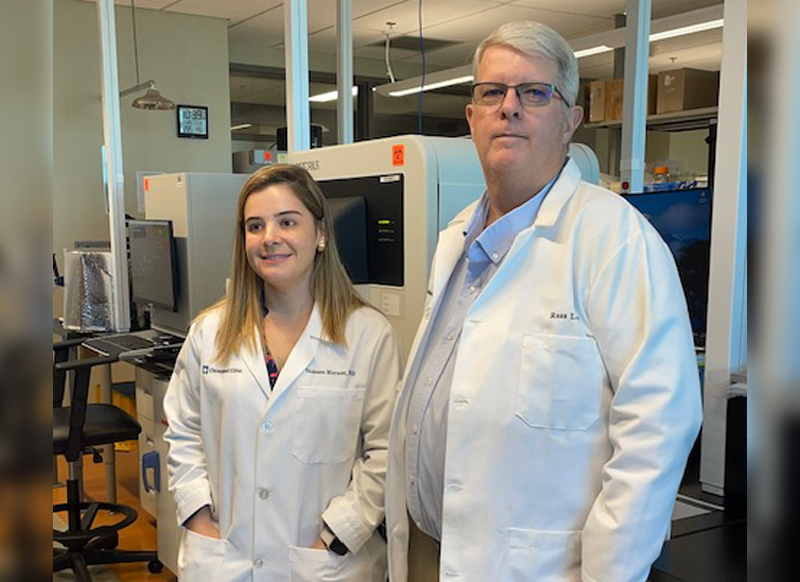
Researchers based at the Florida Research and Innovation Center (FRIC) in Port St. Lucie have been busy working on flu vaccines that are more effective and better suited for different age groups, especially for older adults.
“While flu vaccines are typically evaluated based on their ability to produce antibodies, high antibody levels alone don’t guarantee full protection,” said Dr. Ted Ross, global director of vaccine development at Cleveland Clinic.
“By understanding how vaccines activate cellular immunity, scientists can design next-generation flu vaccines that offer enhanced protection, particularly for high-risk groups like the elderly.”
Ross, who leads vaccine development for all of the Cleveland Clinic network from FRIC, just co-authored a study with Dr. Vanessa Moreas that appeared in the Journal of Immunology that goes beyond traditional flu vaccine evaluation. Ross, the senior author, and Moreas, the lead author, compared four different influenza vaccines and found that the type of immune response varies significantly by vaccine type and patient age.
Trial members in the influenza vaccine study were compared by analyzing cellular immune responses to four seasonal inactivated vaccines. They were categorized by age, with groups 28 to 60 and 65 to 80.
The participants came from Port St. Lucie and Athens, Georgia, and were comprised of 52 healthy adults, 26 from the younger group and 26 from the older group.
“One of the biggest issues we’ve had is outreach in the community,” Ross said.
Many of the volunteers end up being hospital workers. “We have an advertising strategy,” said Ross, who added that volunteers are compensated $30 each time they have to come in for a test or shot.
“Some people are motivated by that and some just want to help,” he said.
In the study recently published, participants were vaccinated with one of four influenza vaccines during the 2023 to 2024 flu season, and blood samples were taken before and after the vaccinations. The vaccines were four of the current flu vaccines on the market.
“The way to see if you’re protected is to look at antibody levels. It’s not very accurate so we went deeper. We compared four different vaccines by young people and the elderly. We looked for the antibodies, they were pretty much the same,” said Moreas. “When we looked for the cellular levels, we saw differences.
“We looked at vaccines made in eggs and one that was made in cells. The ones in eggs is not as good,” Moreas said.
The elderly were given an adjuvant to boost the vaccine, but when compared it was improved but not enough.
Giving the elderly four times the amount of the vaccine was more effective than putting in an adjuvant, the research concluded.
“How does this impact the decisions? Not only look for antibody response but also cellular,” Ross said. “For the elderly you might want to be more selective on what vaccine you get.”
At the moment there are not many choices on influenza vaccines because patients get whatever their physician or hospital buys, and most people do not know what they are getting.
Eggs are worse for the elderly, but egg production is the cheapest. “It is technology from the 1930s and it’s still here today,” Ross said.
People are asked if they’re allergic to eggs before a flu shot because if a recipient is allergic, they will get a different type of flu shot.
“The research offers new insight into tailoring flu vaccines for different age groups and could guide public health advice ahead of future flu seasons. It’s timely given that last year’s flu season was among the most severe in recent years, causing more than 600,000 hospitalizations nationwide, with Florida alone reporting one of the highest rates in the country,” explains a press release about the work.
Continuing study of the influenza vaccine will focus on trying to come up with a universal flu vaccine so that the vaccines would be long lasting and not needed each year.
“A universal influenza virus vaccine that offers broad protection across different virus strains and age groups remains a key global priority,” reads part of the introduction to study which was published recently in the Journal of Immunology.
According to Ross, around 50 percent of people in the United States get flu shots and most of the recipients are elderly.
Tracking the effectiveness of the vaccine or how long it lasts reveals that within a few months, the elderly are back to their baseline, while young adults tend to keep their immunity all year.
“Things slow down as we get older,” Ross said. “We’d like to know how to target people in these populations. Now we make one vaccine to target all.”
Better delivery to better production is needed so the vaccine does not have to be updated each year.
“We’re still a ways away from getting a lifetime flu shot,” Ross said. “You’d get a broader coverage if you didn’t have to change it.”
The peak of flu season is late January and February. A few weeks after the holidays people come to the clinic and say they are feeling bad and they come in for the shot. It takes two to four weeks to get the immune response.
This year’s flu season appears to be a little more severe, according to Ross. But it looks like the vaccine is suited for it.
To further their research, the doctors are seeking local volunteers for continued flu and COVID-19 studies, and local residents interested in helping are welcome.
Flu studies require between four to five visits, with participants receiving $30 per visit. The COVID-19 study requires visits every four to 12 weeks for about two years.
For both studies, eligibility requirements include being between 18 and 90 years old and weighing at least 110 pounds.
RSV vaccine studies are also underway for participants over 60. Testing for children is not approved yet.
For more information about signing up to be part of the studies or to sign up, call 772-692-5143 or email [email protected].