
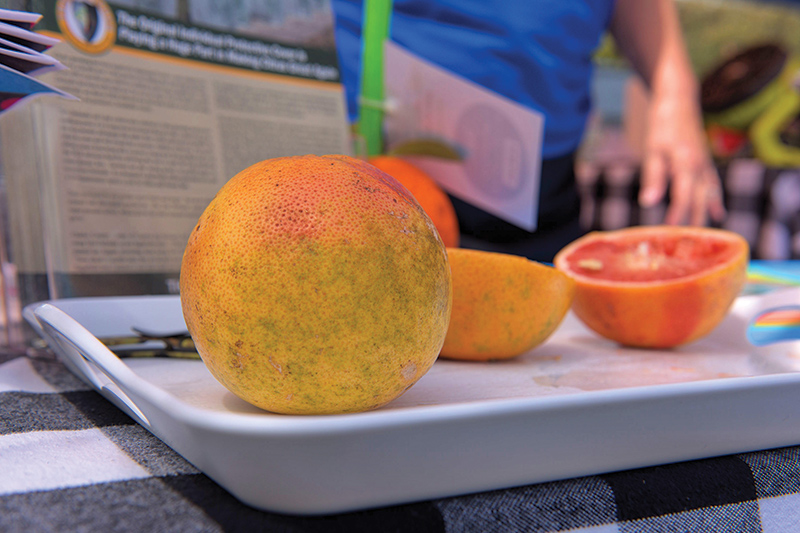
The 2025-26 winter proved daunting for Florida’s citrus industry in both the field and laboratory.
Obstacles, both natural and administrative, beset scientists looking to restore thousands of acres of citrus groves waylaid throughout the state.
They included the ongoing greening epidemic, now in its third decade; the historic February freeze, which left soils in dire need of water; and the 43-day federal shutdown last October through November, which squelched government-backed lab research.
Discoveries unveiled at the 2026 Florida Citrus Show, however, revealed positive steps toward reversing these fortunes: from greater fruit yields to more promising methods in combating invasive diseases among citrus trees.
Studies flooded the U.S. Department of Agriculture Horticultural Research Laboratory, 2001 S. Rock Road in inland Fort Pierce, March 12. Many discussions throughout the day regarded refinements in irrigation and genetic engineering to resist bacteria like Huanglongbing (HLB), responsible for citrus greening. St. Lucie County, alone, lost over 60,000 of nearly 70,000 acres of citrus groves to greening since its 2005 discovery, USDA records show.
One of the day’s first presentations came from Rick Dantzler, COO of Citrus Research & Development Foundation, Inc., and the former executive director of the USDA Farm Service Agency in Florida and the U.S. Virgin Islands.
With his dry wit, Dantzler juggled promise with pessimism in front of farmers and biologists alike reflecting on the preceding winter. “I was going to title my remarks ‘The Best is Yet to Come’ or ‘The Year of the Dumpster Fire,’” he said in his Q&A.
Nearing retirement after years of lab management, Dantzler’s talk veered between apologies for an inability to quell citrus decline and gratitude for efforts among growers and researchers throughout years of struggle. “You’re the ones that are the heroes in this battle,” he said.
Dantzler brought up the recent studies of Dr. Robert Turgeon, a leading researcher with Cornell University, on how gene editing resulted in a near-complete “killing” of CLas (Candidatus Liberibacter asiaticus) – a bacterium adjacent to HLB – among samples surveyed.
“This might just work,” Dantzler said. He added a note of caution: “We may not get lucky, so we need to stay open to the possibility that we are going to require a genetically modified tree in order to have something that withstands the strength of this pathogen over time.”
The race to replenish fallow citrus fields, particularly Valencia oranges for juice, could come down to growers being able to offer either an expensive product or no product at all.
“We’re going to lose a few (customers) – no question about that,” Dantzler said, “but every grower in this room can sell every single orange they grow for the rest of their biological lives (at a profit), assuming the quality is there. You can’t let ‘perfect’ be the enemy of the ‘good.’ Once it’s good enough, we got to go with it; growers need it now.”
The body of research that made up the Citrus Show’s presentations drew from years of work conducted between facilities in inland Fort Pierce and others in rural Florida.
Explaining the genetics behind greening prevention fell to Dr. Manjul Dutt, an assistant professor with the University of Florida’s Institute of Food and Agricultural Sciences (UF/IFAS).
Greening, being a “phloem-limited disease” isolated to a citrus tree’s connective tissue, required studies spanning approximately “six to eight months” to discover and target genes to quell it, Dutt said.
“Once they get infected, you have to actually have a process to kill the bacteria,” he added of citrus cells’ vulnerability to insect-borne ailments.
Dutt and his associates found resistance from bacterial infection to be “stably integrated into the DNA of a citrus plant,” as it gestates between five to seven years, he said. “When we have produced these genetically modified plants, we actually go and ask the USDA for a permit to put them out.”
To emulate actual growing conditions, these studies went straight to the land instead of a lab. “Our group has skipped the greenhouse experiments,” Dutt said. “In many cases, we have seen that greenhouse experiments, sometimes, do not mirror real world issues.”
Dutt’s assertions were echoed by Robert Shatters, Ph.D., a USDA molecular biologist at the Hort Lab. He stood in for Peter McClure, a produce safety inspector with the Florida Department of Agriculture and Consumer Services.
Similar months-long assessments showed promise in combatting greening and other bacterial citrus diseases like canker and citrus gall, the latter of which forms unsightly growths on tree bark.
“Our initial, preliminary work shows that we are affecting those bacteria, preventing that insect from growing,” Shatters said, referring to Asian citrus psyllids and other disease-carrying vectors.
This project led to the development of genetic molecules that could instruct bacteria to die off before reproducing enough to sicken a plant.
“When everything was right and we were getting a lot of (molecule) production,” Shatters said, “we were able to reduce our symptoms compared to our controls in the regrowth of trees.”
The next steps in this direction will have the team “optimizing” citrus plants and their interaction with genetic material until they “could do the work for us,” Shatters concluded.
Research rooting these issues stemmed from people like Hope Morris, a Ph.D. student working under Dr. Flavia Zambon, assistant professor with the UF Indian River Research and Education Center and one of the day’s moderators.
Morris’ work surrounds soil amendments, which can keep citrus trees “healthier at a younger stage,” she said. “When the soil is healthier, it’s going to retain the water (and) nutrients. In Florida, we have the sandy soil which is more difficult to deal with.”
One approach Morris and her colleagues refined was the use of “precision irrigation,” she said. Too much watering among some farms led to excess runoff including nitrogen from fertilizers that fed into local canals and the Indian River Lagoon.
“You water only enough to give your trees what they need to grow and give you the highest yield,” she said. “The common practice was just to water as much as possible, but then it just runs the nutrients out of the soil.”
She added, “the generational farmers, that have been here forever and ever, they’re the ones who figured that out.”
Ute Albrecht, Ph.D., presented work among trees injected with oxytetracycline (OTC), an antibiotic used to stave off greening. Her team traced several trees injected with the substance to determine how much would be enough to give fruit in a three-year period.
According to studies Albrecht presented, each of the five trees surveyed yielded approximately 100 pounds of fruit. Trees in a control group without OTC gave baseline totals between 80 and 100 pounds; trees with the highest OTC concentration gave a more consistent average of around 120 pounds with less room for error.
Fruit yields decreased drastically by December 2024, owing to Hurricane Milton. “We lost about 50 percent of our fruit,” Albrecht said, adding her study found the control trees suffered the most damage compared to a range of OTC trees.
The crop rebounded by “almost triple” that total by January 2026, Albrecht said. The control trees still gave a weaker yield while those with the highest OTC concentration gave nearly 150 pounds worth of fruit on average.
Caution still remained as advancements in citrus health still had room to develop.
“I would advise against just mixing things with OTC until you have proven (it) actually works,” Albrecht said, adding a recommendation that growers follow directions on injection.
“You can, hopefully, stay in business until we have the ‘tree of the future,’” through genetic modification or other means.