
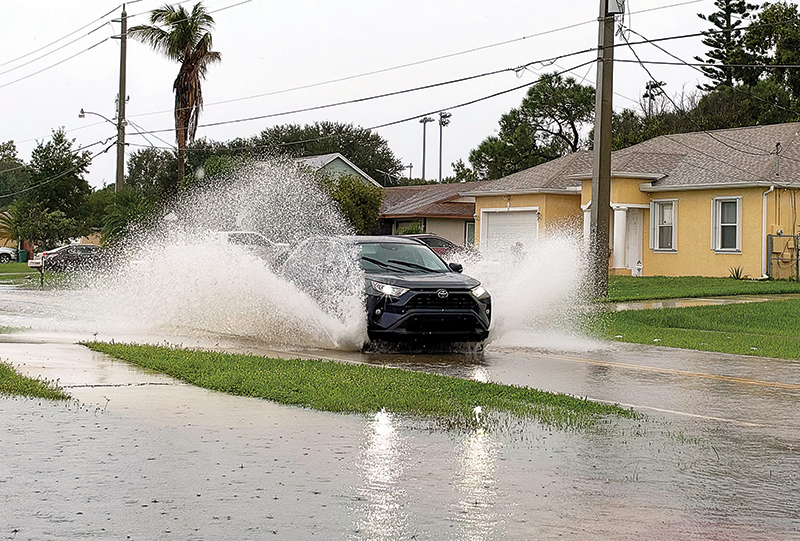
Drone photographer Donnie Mahuron, 67, has documented the aftermath of “about six or seven” major storms and hurricanes, he said Nov. 5.
But those differed from his work after the brisk, unrelenting rainfall of Nov. 2.
The aerial shots he gathered exposed the “worst” flooding he’d seen in 25 years in St. Lucie. “I’ve just never seen anything like it.”
Throughout the week, homeowners hired Mahuron to photograph properties – suburban and rural alike – threatened by torrents that arrived with little warning.
It left reservoirs overflowing in vulnerable places. Arterial roads, like “California (and) Savona” boulevards, to Mahuron, “always flooded” for 20 years. “It still floods now.”
But it was troubling for Mahuron to see standing water remain for days “in a modern-day community,” like Valencia Cay in Tradition. “At first, you couldn’t get through the gate,” he said. “It was like that for the next three or four days; it had hardly gone down.”
Already sodden by over a month of storms since September, up to 16.7 inches of rain fell throughout St. Lucie on Nov. 2, according to the National Weather Service.
Most of it fell further inland, flooding developed communities from Becker Road and Tradition in the south to Lakewood Park. Many of these places, by 11:50 a.m., were deluged with the same amount of rain or worse carried by Hurricane Milton two years ago.
Farmland and cleared lots alike buckled under intense storms. Parts of southwest Port St. Lucie incurred as much as 13.44 inches, while Tradition absorbed 12.12 inches.
Accounts from the CoCoRaHS volunteer weather group matched these findings. Some, like in Indian River Estates and White City, failed to report after upwelling from the St. Lucie River and other waterways overtook homes.
By 7 a.m., a volunteer in Tradition gathered 6.74 inches, calling it “the largest single-day total” collected in 18 years surveying there. Two more along Port St. Lucie Boulevard logged as much as 6.24 inches. One readout added the area incurred 11.92 inches between Nov. 1-2 and 15.69 inches across the entire weekend.
Similarly, a station in River Park recorded 6.71 inches “after emptying” 5.85 inches from Halloween weekend, said its volunteer report. “I had no idea what was to come.”
Signs of adverse rain had existed before Nov. 2, from NWS’ foreboding “above normal” rain forecast for the dry season from now to the spring.
But the flooding came without much of the same warning. El Niño-fed air currents inundated Arizona, Colorado and the land surrounding Lake Okeechobee the same day, NWS reports say.
Up to another foot of rain, along with chillier weather, was to descend on south Florida in storms throughout this week, according to NWS Miami. Flood watches from Tuesday to Friday emerged as early as 3:18 p.m. Monday.
“Forecasting rainfall events can be difficult, as seen with this latest event,” said NWS Melbourne Meteorologist Megan Tollefsen.
Flood warnings popped up as storms from Oct. 30 onward intensified. They evolved quickly from a “slight risk of excessive rainfall,” she said, to a far worse outcome exacerbated by Florida’s water table.
Low-lying terrain filled with lakes and streams continue to hinder accurate water readings, even if they upwell. The need exists for “better modeling that captures rainfall events and their totals,” she said. “But even still, it can be difficult to capture the extremes.”
Relief efforts and drainage also strained to capacity.
The St. Lucie Fire District responded immediately to approximately 120 calls for rescue out of 518 monitored, according to interim Chief Paul Langel in a Nov. 3 briefing.
Two temporary shelters opened for those displaced, county releases added. The Northport K-8 School (250 NW Floresta Dr.) received 16 people among the general population, according to St. Lucie spokesperson Erick Gill. Another five made their way to a makeshift special needs shelter at the Havert L. Fenn Center (200 Virginia Ave.).
A Port St. Lucie program to give homeowners up to $25,000 in repairs stopped after the city received “approximately 400 applications” by Nov. 9, according to spokesperson Scott Samples. Their window stayed open for “less than a week.”
“The pause will allow staff to review and process the applications on file,” Samples added. The program uses $1 million provided by the Florida Housing Finance Corporation.
Many, like Mahuron, joined a litany of St. Lucie homeowners taking aim at “developers,” he said, of building over drainage that couldn’t work to capacity. “They’ve just built out too much.”
Janelle and Rebekah Hertz spent Nov. 3 navigating Lakewood Park by kayak. Water overran the triangle along Pandora Avenue as they abandoned their home a mile north near the St. Lucie/Indian River county line.
The main canal along nearby Green Dolphin Street pumped excess stormwater that “filled to the rim,” said Janelle Hertz. Pumps nearby, rented to reroute water since 2018, spewed sickly brown water as it crept to street level.
Water spilled onto side streets spanning around 2.25 miles north to south. The Green Dolphin Canal, still waiting for $3.6 million in repairs, could barely hold anything.
“This was all a park,” Rebekah Hertz said. She paddled as she saw loose hubcaps from “stalled vehicles” that ran aground of mailboxes or took on too much water. “We’re used to rain, but this was extreme.”
Marshlands farther east faced similar duress, said Matthew Blackwell. Formerly from Ocala, he spent Nov. 3 surveying ponds that formed near his Arcadia Avenue home along Indrio Road.
“I haven’t seen any flooding like this ever; this is the most severe flooding I’ve ever seen,” Blackwell said. The water filled past an old depth meter in the grass around plats without “the proper drainage” to hold up past the storm.
Blackwell also spoke with a retired friend left stranded at home in Holiday Pines, a Lakewood Park suburb afflicted by the flooding and Milton. The water, added Blackwell, prevented him from going out “to vote” or “to the grocery store.”
Farther south, rural communities like St. Lucie Gardens endured the floods after a month of sustained rain left pastures uninhabitable under a foot of water.
Alyssa Sims, 27, and Destiny Josephs, 19, rode slowly on horseback along the cratered mud of Shanas Trail. They escorted Josephs’ Kia sedan, which barely escaped the floods, driven by Wyatt Tracy, 18.
Both women worked through Nov. 2. “You just have to work through the rain,” said Sims. Her trip home “was like swimming through the trenches.”
“I actually had to leave my car,” said Josephs. “It took me over 24 hours to get my car back.”
To Josephs, the episode presented a “very scary” possibility that she would be left to care for her grandmother in a sparsely populated rural neighborhood without a car to drive. “I do all the errands for her and get her meds.”
Tracy was stranded at home while water drenched Shanas Trail, he said. Cut off from work, water sloughed off between him and the “parking lot” of the neighboring Silver Oaks townhouse community.