
“Legends of the Highway,” a film featuring nine of the original 26 Black landscape artists from Fort Pierce and the Gifford community in Vero Beach who sold their paintings from the trunks of cars up and down Florida’s Atlantic coast during the 1950s, ’60s and ’70s, had its premiere in Jupiter on Oct. 25.
The film is now available on DVD and to rent or purchase on Amazon Prime.
Known today as the Florida Highwaymen – actually, 25 men and one woman – the artists represent one of America’s last and most interesting artistic movements. Led by Alfred Hair and Harold Newton, the artists churned out thousands of colorful images of Sunshine State vistas painted on Upson boards – inexpensive fiberboard made from compressed wood fibers.
All 26 artists were inducted into the Florida Artists Hall of Fame in 2004, honored alongside such notables as musicians Ray Charles, Gloria Estefan and Jimmy Buffett, writers Ernest Hemingway and Marjorie Kinnan Rawlings, and Fort Pierce artist A.E. “Bean” Backus, from whom many of the Highwaymen drew inspiration.
The film opens with the message “inspired by true events” and takes some liberties with certain facts and timelines, but it captures the spirit of determination and perseverance that fueled the artists’ remarkable success in the face of racism in the Jim Crow-era South.
They were not civil rights activists or freedom fighters, says the actor portraying Mary Ann Carroll, the lone female artist in the group, at the beginning of the film. Rather, they were just trying to create a better life for themselves and their families.
Kelvin Hair II, Alfred Hair’s grandson, portrays his grandfather in the film. A veteran film actor, this role “was a dream come true,” Kelvin II told our sister publication Vero Beach 32963. “For this moment to come together now is surreal. I am honored and blessed to be able to tell his story.”
The film’s theme of refusing to let obstacles get in one’s way as you fight to get what you want resonated with him, he said. “That is something that must run in the blood because I feel it running through my veins.”
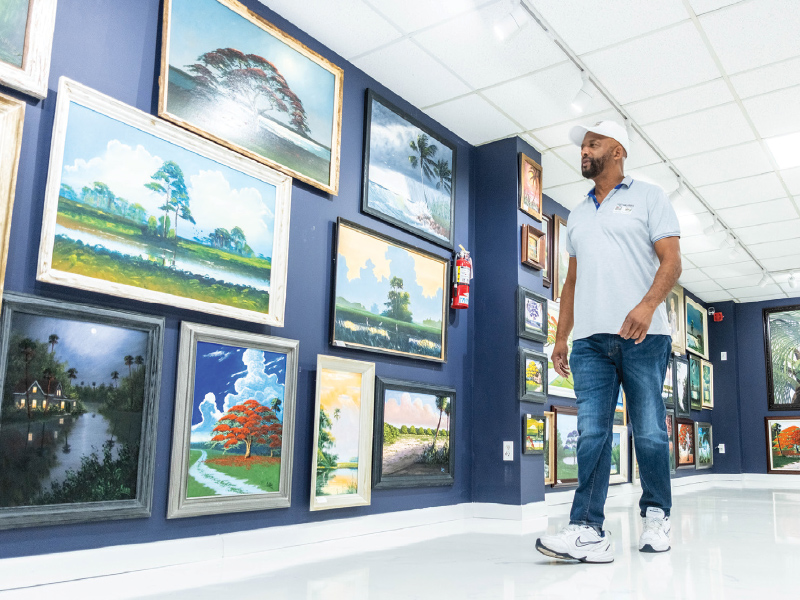
“It’s absolutely a marvelous story,” said Ralph Oko, who has been displaying and selling Highwaymen art since 2010 at his gallery at 1872 Commerce Ave. in Vero Beach. “I went into the movie expecting to see a story aimed at people who are not aware of the Highwaymen and that’s what I saw. These talented young artists developed a trade all their own and now it is their legacy.”
Having Kelvin Hair II portray his grandfather “was a beautiful bit of casting,” Oko said. “These men persevered at a time when they couldn’t go where everyone else were allowed to go. Alfred Hair was the Henry Ford of the Highwaymen – creating two dozen or more paintings in a day. Sometimes the paint was still wet when they sold them. I love to see stories of people who take a chance and make a radical change to improve their lives.”
Alfred Hair was a student at Lincoln Park Academy in Fort Pierce when art teacher Zenobia Jefferson invited famed local artist A.E. “Bean” Backus to meet some of her students. Backus was impressed with Hair, just 14 at the time, and invited him to study painting at his studio.
Harold Newton also admired Backus’ work, but preferred to paint on his own, allowing nature to inform his style. Soon, some of the other young Black men, and Carroll, began to take notice and tried their hands at painting, too.
Newton was the first to start selling his paintings door-to-door. The group had found a way to escape the drudgery of picking fruits and vegetables in the heat of the Florida sun. Most paintings sold for $25 to $35, which was a lot of money then. Today, paintings by the original Highwaymen sell for tens of thousands of dollars to collectors.
But Hair’s quick rise to fame and fortune ended tragically when he was shot to death during a dispute in a Fort Pierce barroom on Aug. 9, 1970. He was just 29.
An Alfred Hair painting of a brilliant Royal Poinciana tree adorns a specialty Florida license plate being sold to raise funds for a Highwaymen Museum now under renovation in Fort Pierce.
“He didn’t have a chance to fully mature, so of course he did sort of crazy things with that kind of money,” said Kelvin Hair Sr., Alfred’s son and Kelvin Hair II’s father. He was only 5 years old when Alfred was killed, but as he grew older he was drawn to his dad’s style of painting, albeit more slowly and with more detail. “It’s got to be in my DNA, imprinted on me from my dad,” he said. He started drawing and painting, first at Vero Beach High School, and later at Westwood High School in Fort Pierce.
“Mom took me to meet Bean,” he said. “That was when I learned how generous my father was in the community. Think about it – he’s 19, 20 years old and he’s making $500 or $600 a day, more money than any adult in town. He bought cars for his salesmen. He had clothes specially made for him. In those days you could buy a brand-new Cadillac for two grand.”
Alfred’s money and braggadocious demeanor also got him into trouble, Kelvin Sr. said. “He was kind of a womanizer, which wasn’t really touched on in the film,” he said. One theory about the shooting was that Julius Funderberk, a migrant worker, shot Alfred because he believed the artist made a pass at his girlfriend.
But that story varies, depending on who you ask, Kelvin Sr. said. Funderberk was convicted of second-degree murder, was sentenced to life in prison, but was paroled after serving seven years.
Kelvin Sr. got serious about painting around 2000 when interest in the Highwaymen began to rise again. Today he owns a studio and gallery at 111 Orange Ave. in Fort Pierce featuring his work and the work of Highwaymen and other Florida artists.
Gifford resident Roy R.A. McLendon is portrayed in “Legends of the Highway” picking oranges alongside Alfred Hair. While the two never picked fruit together, they were best friends later on, says McLendon’s son, Ray McLendon, who sells reproductions of his father’s paintings along with his own landscapes created in the Highwaymen style at a studio and gift shop located at 1935 14th Ave. in Vero Beach. The elder McLendon died in 2024.
“My dad lived near Harold Newton’s house here in Gifford and he studied Harold’s work,” Ray McLendon said. “I saw all these talented people come around and watch Harold and my daddy paint.” But unlike the film, his father didn’t visit Backus with Hair. “Daddy preferred to just do it and learn as you go.”
Ray McLendon wanted to study art at Kutztown University of Pennsylvania, but when he found out it wouldn’t leave enough time to play on the college’s basketball team, he chose to study social work instead. He painted on the side, but they were mostly abstracts, he said. After his father visited him and his mother in Pennsylvania, hoping for a reconciliation after they split, Ray took a greater interest in landscapes.
Selling products door to door was common in the ’50s and ’60s, so it didn’t take a brainstorm to sell paintings that way, McLendon said. The difference was, Black salesmen were only welcome at the back door, not the front, he said. So they approached businesses instead. “My daddy never stopped painting but there were plenty of days that he didn’t sell anything,” he said.
After operating the R&B Crab Shack in Fort Pierce for 25 years, McLendon transferred the restaurant to his son 15 years ago and began to paint full time.
Roy A. McLendon Jr., Ray’s brother, also creates similar landscapes and operated a studio and gallery in the Three Avenues Shopping Center, which is now closed. Efforts to contact him for this story were unsuccessful.
“Legends of the Highway” shows the men painting together in large groups, but the film’s writer and director, Marquand Ragland, admits that didn’t really happen very often. “I think we did a good job of telling the story of who the Highwaymen were as a collective and their contribution not only to the Florida art scene but to the art community around the world,” Ragland said.
Ragland, a veteran who served in the Marines in Afghanistan and Iraq, was approached by Doug Schwab, a producer at Maverick Entertainment, about directing the film. “Once I did my research and learned about the amazing subject matter, I was in. I signed on right away,” Ragland said. When he was told Kelvin Hair II, whom he knew well from other films, was Alfred Hair’s grandson, “it made the project even more special.”
Kenny Holmes, a Vero Beach native and former NFL football player for the Houston Oilers, New York Giants and the Green Bay Packers, was also a backer for the project. Holmes also coached football at Vero Beach High School from 2008-2010.
Harold Newton passed away in 1994. Mary Ann Carroll died in 2019.
Only four original Highwaymen artists remain, including Willie C. Reagan, who still lives in Gifford. Reagan was the most educated of the group, having majored in art at Florida A&M University. Later he taught art at schools in Indian River County for more than 30 years.
“He was not really painting to earn money,” said Joy Gaillard, Reagan’s daughter. Her dad was not feeling well enough for an interview, Gaillard said. He is suffering from lingering effects from pneumonia and a bout with Covid. “Art was a way for him to relax. Choosing Florida landscapes as a subject was not necessarily on purpose, it was a rare circumstance that it ended up that way,” she said.
Reagan’s paintings stood out from the other landscapes because he extended his images onto the frames, calling them “panoramics,” Gaillard said. “He thought they looked better that way. It was his signature style and people just loved the way he did that.”
The other remaining Highway men are Sam Newton, who lived in Gifford during the ’60s and ’70s but now lives in Merritt Island; Curtis Arnett, who was raised in Fort Pierce but now resides in North Florida; and Robert L. Lewis Jr., who grew up and lives in Cocoa, Florida.
“It’s great when authors and filmmakers become interested in the art and the artists we know so well,” said J. Marshall Adams, executive director of the A.E. Backus Museum in Fort Pierce, which houses a permanent exhibition of Highwaymen paintings. “It’s important that these stories are continually researched and respectfully told, and it’s exciting when a new article, book, documentary, and now a film can enter into the public discourse to tell and retell them for new audiences to discover.”
Another premiere screening of “Legends of the Highway” is scheduled for 2 p.m. Nov. 23 at the Lyric Theatre in Stuart. Tickets are $35. Additional premieres of the film will be screened at Cinépolis theaters in Orlando and Miami, Ragland said. Negotiations are in progress to bring the film to a major streaming service the week of Thanksgiving, he said.