
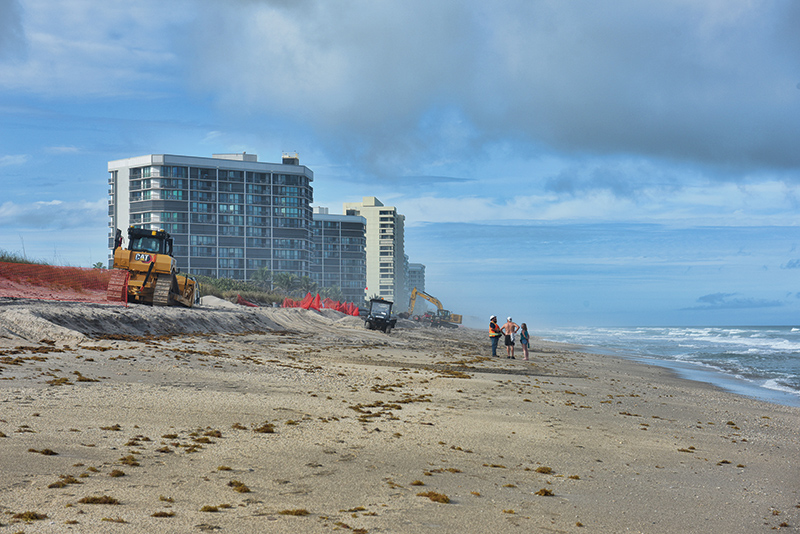
The U.S. Army Corps of Engineers began work to repair approximately 3.3 miles of South Hutchinson Island shorelines Jan. 22 in continuing efforts to stave off coastal erosion.
Contractors from Manson Construction Co. started dredging sand dunes along Dollman Beach, 9200 South Ocean Drive/State Road A1A, in a $14.7 million, six-month project fully funded by the Army Corps.
The beach has been intermittently closed to visitors since Jan. 5 and will continue facing closures from now until the project’s completion, slated for Jun. 30, county releases circulated since Dec. 18 say.
Like other projects to restore county beaches, the Dollman Beach renutrition project will derive its sand from St. Lucie Shoals found 3.5 miles due east in the Atlantic. County records say the project will divert approximately 315,000 cubic yards of sand from this source near the Continental Shelf farther out in the ocean.
Much of the erosion that has affected Dollman Beach exists near condominium complexes frequented by vacationers from the north, and wealthier estates found in both directions along the coastline.
The afternoon of Jan. 22 saw workers from Manson turn visitors away from their walks north of the Dollman Beach entrance. Ocean spray and colonies of gulls veiled heavy machinery amid the escarpments and fresh strings of seagrass that intensifying rip tides left behind since the summer.
The project has not gone unnoticed among visitors like Carolyn Wilson, 82. She rummaged for seashells near Army Corps signage on sand 2 feet above the emerging waterline. Wilson has wintered in Hutchinson Island with an immunocompromised friend since 2021, after years vacationing at Sanibel Island.
“I used to, originally, go over to the Gulf Coast,” Wilson said, “but we just like the heartier sound of the waves over here.” She and her friend make use of their condo found in tropical territory on doctor’s orders. “We’ll just sit up on our balcony and just listen to them; such soothing sounds.”
Wilson, originally from Virginia, said the erosion on nearby beaches last year was “maybe half as bad as” the escarpments present at Dollman today. “We were down in the Marriott (Hutchinson Island Resort) last year, and there wasn’t much erosion down there at that time.
“We’ve never been here when they’ve had hurricane warnings,” Wilson said. “Hopefully, it’ll all be nice and smooth and level again. I’ll definitely be back again next year. I, certainly, wouldn’t want to be in a single-family, ground-level type thing, but we totally feel safe where we are right now.”
Jeff Brooker, also a Virginian who vacationed in South Hutchinson Island for nearly five years, observed how increased Atlantic tidal activity had eaten away at local beaches over time.
His condo, he said, gave him access to “fishing on the sound and beach life” that he couldn’t find during winters in northern Virginia. Storms that swept through or near St. Lucie, along with “rising sea levels,” brought renewed attention to the nearby sands. “It happens from time to time. We’ve had a couple bad storms the last few years.”
The consecutive emergence of hurricanes Humberto and Imelda in the Caribbean between September and October wrought “very rough” king tides that further ate away at the beach, Brooker said. “A lot of erosion had occurred.”
“It’s not unique to this area,” Brooker added. He had seen similar coastal erosion along the Eastern Seaboard, including near another vacation spot in Cape Hatteras, N.C. Beaches there sustain escarpments from tides influenced by canyons along the Continental Shelf, along with storm activity, according to the National Oceanic and Atmospheric Administration.
“The erosion is devastating,” Brooker said of Hatteras. He added the erosion at Dollman “isn’t as bad as that but it’s, obviously, a great concern.”